News
Asian markets plunge on 25 November as tariff fears return
Asian markets plunged on 25 November 2026: South Korea's Kospi fell 5.6%, Japan's Nikkei 3.6% and Taiwan's Taiex more than 6% as fresh US tariff threats and AI doubts hit chip shares.
By Bikram LamaPublished 5 min read
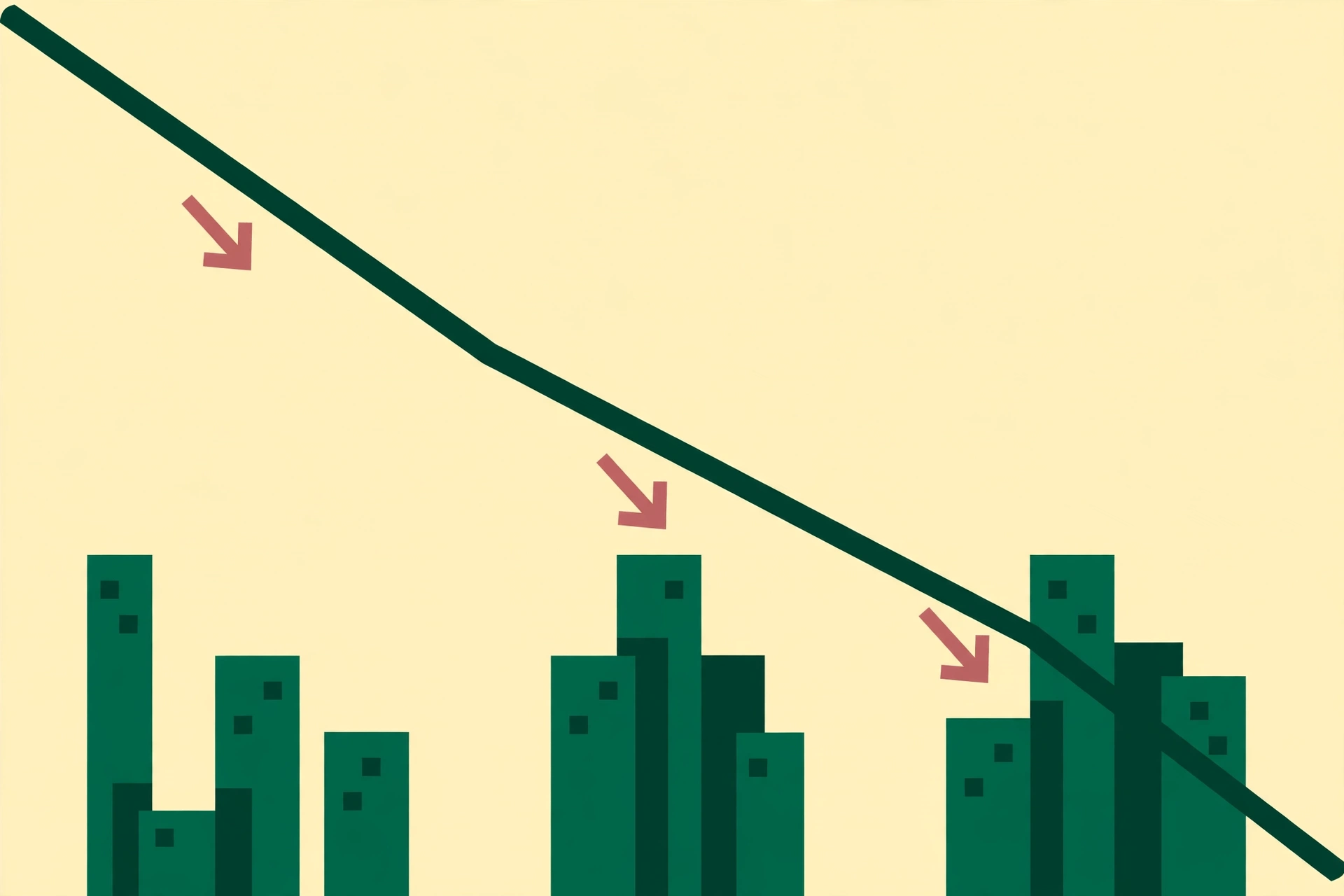
Asian stock markets fell sharply on Wednesday 25 November 2026, with South Korea, Japan and Taiwan all down heavily as fresh US tariff threats and renewed doubts about the artificial intelligence trade hit chip shares. South Korea's Kospi lost 5.6%, Japan's Nikkei 225 fell 3.6% and Taiwan's Taiex dropped more than 6%, reversing much of the rally the same markets had posted a day earlier.
What happened
The selling was concentrated in the chip-heavy markets that had led Tuesday's rebound. In South Korea, the Kospi closed down 5.6% at 4,725.84, falling back below 5,000 a day after closing above that level for the first time, with Samsung Electronics down 9.1% and SK Hynix down 8.6%.
Japan's Nikkei 225 dropped 3.6% to 56,502.97, with SoftBank Group, an investor in OpenAI, down 16.1% and chipmaker Kioxia down 15.4%. The broader Topix fell only 1.2%, so the selling was narrow. Chip and technology shares fell, not the whole market.
Taiwan's Taiex tumbled more than 6% at the close. TSMC, the world's largest chipmaker, sank 8.1% and chip designer MediaTek fell 10%, after the index had been down as much as 7.9% in morning trading.
Elsewhere in the region the picture was mixed. MSCI's broadest index of Asia-Pacific shares outside Japan was down 2.3%, but Hong Kong's Hang Seng rose 1% to 22,449.86, regaining ground after closing the day before at its lowest in more than a year. Shanghai's Composite index fell 0.9% to 3,515.05, and Australia's S&P/ASX 200 edged 0.5% lower to 8,683.90.
The scale
The falls were large by the standards of a single day. A drop of 5.6% on the Kospi is the kind of move that usually comes with a clear trigger, and this one had two: a possible new round of US tariffs and a fresh wobble in the AI trade.
The US session that set the tone was mixed rather than a rout. On Tuesday, the S&P 500 fell 0.50% to 7,201.09 and the Nasdaq Composite fell 1.48% to 23,733.54, while the Dow Jones rose 0.85% to 50,018.70. Nvidia, the stock at the centre of the AI trade, fell 5.9% after surging in the previous session, and the Philadelphia Semiconductor Index fell 7.88%.
The scale is clearest against Tuesday. The Kospi had jumped 6.32% on Tuesday and the Taiex 9.0%, after Nvidia restored Jensen Huang as chief executive and US tech shares rallied, and Wednesday took most of that back in one session.
The Kospi's fall also triggered the exchange's own safety mechanism, a sell-side sidecar activated by the Korea Exchange at 09:08 KST that suspended program sell orders for five minutes after KOSPI 200 futures fell 5.12% to 738.20. The sidecar triggers when the futures index stays down 5% or more for one minute, and it was the mirror image of Tuesday, when a buy-side breaker was triggered as the Kospi surged more than 6%.
What triggered it
The tariff threat came from reports that the US Trade Representative's office is preparing to release the findings of a probe into alleged excess industrial capacity among 16 major US trading partners, including China and the European Union. Three people with knowledge of the matter said on 24 November that the findings could pave the way for new tariff measures, and USTR Jamieson Greer is expected to unveil the results as soon as this week, though the timing could change.
The reports landed in a market already nervous about the AI trade. The rally in chip shares has been fast and volatile all month: sharp rises followed by sharp falls, with each session's move reversing the one before, and Wednesday's selling followed that pattern, the previous day's winners becoming the day's biggest losers.
Australia's October inflation data added to the unease in the region, with consumer prices up 4.9% from a year earlier, above expectations, and the annualised trimmed mean measure of 3.8% still running well above the Reserve Bank of Australia's target. The Reserve Bank has already raised rates by 125 basis points in 2026, and the data puts pressure on it to do more.
Who is exposed
The people most directly affected are the ordinary holders of the region's big chip shares through index funds and pension funds, because the Kospi, the Nikkei and the Taiex are all heavily weighted towards a small number of large technology companies, so a fall in Samsung, SK Hynix, TSMC or SoftBank moves the whole index. A saver holding a broad Asian or global index fund holds these companies whether they follow the market or not, and a 5% or 6% fall in an index shows up in the fund's value the same day.
That is the general picture. What it means for any one person's savings depends on what they hold and when they need it.
What happens next
Two things are due in the coming days. US core PCE inflation data, the Federal Reserve's preferred measure, is due on 25 November, ahead of the Thanksgiving holiday, and US markets are closed on Thursday for Thanksgiving and reopen on Friday for a shortened session, so the next full US session comes on Monday.
The other is the USTR findings themselves, which the reports say could come as soon as this week, though the timing could change, and which would only start a process. The findings would pave the way for tariff measures rather than impose them. Until the findings are published, the market is reacting to reports of what they might contain, not to a decision.
Last verified 25 November 2026. This is a developing story.
Sources
- Asian stocks tumble as tariff fears return, The Straits Times (Reuters/Bloomberg) (read 25 November 2026)
- Asian stocks slide as AI sell-off deepens, Taiwan falls more than 6%, National Herald India (Associated Press) (read 25 November 2026)
- Seoul shares down over 5 pct late Wed. morning on tech rout, Yonhap News Agency (read 25 November 2026)
- Asian Stocks Mostly Lower on AI Doubts, Tariff Jitters, The Wall Street Journal (read 25 November 2026)
- Asia's stock markets dive as doubts swirl over AI boom, Al Jazeera (read 25 November 2026)
- Asia Chip Stocks Plunge as Nvidia Rout Spreads, AsiaToday (read 25 November 2026)
- KOSPI plunges 5.3%, Nikkei falls 2.9% as Nvidia-led tech rally fizzles; US tariff fears hit Asian markets, Moneycontrol (read 25 November 2026)
- KOSPI Plunges 4.9% as Philadelphia Semiconductor Index Tumbles 7.9%; Sell-Side Circuit Breaker Triggered, Biggo Finance (read 25 November 2026)
An AI assistant helped write this article.
Keep reading
News
Japan, South Korea and Taiwan: Asian markets plunge as AI doubts deepen
Japan's Nikkei fell more than 4% on 20 November 2026, South Korea's Kospi lost about 5% and triggered a trading curb, and Taiwan's Taiex closed down 6.23%.
7 min read1 view

News
South Korea's Kospi falls 3.31% as the AI sell-off extends
South Korea's Kospi closed down 3.31% at 4,708.54 on Monday 23 November 2026, its lowest close since January, as the AI sell-off continued and the government said stabilisation funds were ready.
5 min read3 views
News
Taiwan: Taiex falls 4.40% on 19 November as Asian tech sell-off deepens
Taiwan's Taiex closed down 4.40% at 38,426.89 on 19 November 2026, its third sharp fall in four sessions, as Asian tech stocks sold off on chip-export and rate worries.
4 min read2 views

News
Taiwan and South Korea: Asian markets fall sharply as Nvidia uncertainty spreads
Taiwan's Taiex fell more than 4% on 16 November 2026 and South Korea's Kospi lost about 2.8%, as doubts over Nvidia spread across Asian tech stocks.
4 min read1 view