Guide
Expense tracker app for students: Lipi for semester money, roommates and a free start
Lipi is the expense tracker app for students: free to start with no bank link, budgets that fit lump-sum semester money, free splits for roommates, and multi-currency accounts. Premium costs USD 3 a month, or USD 2 a month billed yearly (USD 24).
By Bikram LamaPublished Updated 19 min read1 view
Lipi is the expense tracker app for students: free to start, no bank link, and budgets that fit lump-sum semester money.
Student money does not arrive like a salary. It lands in large, infrequent lumps, a financial aid disbursement, a transfer from family at the start of term, summer savings, plus small variable pay from a part-time job. That money has to stretch four or five months. On top of that, a student usually has almost nothing to spend on the tracking app itself, shares rent with roommates, and pays for four to six subscriptions. A tracker built for a monthly salary handles none of that well.
Open Lipi and set up your student book today. Tracking, budgets and splits are free, and the setup takes an evening.
Why student money breaks a normal budget app
The first problem is the lump sum. BestMoney, writing for students, calls it the semester budget divide problem: a $5,000 disbursement in late August should be treated as $1,000 a month across five months, not $5,000 to spend freely. A tracker that shows the whole lump sum as this month's money makes the first month look rich and the fourth month look like a crisis, when nothing changed except the calendar.
The second problem is the price of the tracker itself. A student budget has no room for a $109 a year subscription. The app has to be free at the point where the money is tightest, or it is not a student app at all.
The third problem is the stack. DailyGenius describes the average student as managing a checking account, a debit card, maybe a credit card, student loans, four to six active subscriptions, a payment app balance, and rent split three ways. A tracker with one wallet and one budget cannot hold that. A tracker that needs a bank link for every account cannot hold it either, because a student is not going to link every account they own to a budgeting app.
And the fourth problem is roommates. Rent, internet and groceries are shared, and the person who paid needs to know who owes what without keeping a separate spreadsheet. A tracker without splits pushes that job outside the app, where it is forgotten.
What students find when they try the usual apps
The low-star reviews of the apps students usually try first repeat the same complaints. They are worth reading before you pick one, because the pattern says more than any single review.
The first complaint is an app that stops working after an update. A Google Play review of Spendee from Andrey Greshnev, dated 15 September 2026, reads:
"Spendee team, start reading the reviews please - you're killing your app! I'm using it for 3 years and with latest updates app became impossible to use. First the major UI change - too quick and confusing. Then the freezes all over the app - have you even tried categorizing 100+ expenses in the end of the month now? And now I can't even register a transfer from my bank account. I withdraw money in cash, but the app only allows me to register expense instead of transfer. Come on!"
Cash withdrawals and transfers between your own accounts are a student's daily routine: cash out, pay the roommate, move money to the spending account. An app that records a transfer as an expense corrupts the month.
The second complaint is student loans counted the wrong way. A Google Play review of Spendee from Victor Fong, dated 17 November 2025, says:
"Unfortunately there is one massive issue that will prevent me from continuing with the app for now. If you link your credit cards, car loans, student loans, etc, it will not count against your net worth, but instead it will ADD to your net worth! If your intention was to see how much money you have free after factoring in credit card balances, this app cannot suit your needs."
A student loan is a debt, not an asset. A tracker that adds it to your net worth tells you that you are richer than you are.
The third complaint is a paywall on a feature that used to be free. A Google Play review of Money Lover from Emily Meeks, dated 27 September 2021, says:
"I have enjoyed using this app to track my money for years, but recently I switched to a new phone. When trying to restore my recurring transactions, I found that I now can only have 1 recurring transaction without paying $35 for a premium account. That's pretty scummy for a feature that was once free and is standard in most money tracker apps. I will be switching to a new app to track my expenditures."
Students change phones often, and rent, phone bills and subscriptions are all recurring. One free recurring transaction does not cover a student's month.
The fourth complaint is currency conversion going wrong. A two-star Google Play review of Toshl Finance reports:
"Buggy. Would connect my Inter Brokers account, show the balance, but not reflect in Net Worth, the report was just wrong. Two other bank accounts would not connect, even though Tosh shows them as added/synced, but no transactions. Manually added transactions would not appear in the reports. Currency conversions sometimes work, but not sometimes applied (I would type 123 EUR and the app would show $123 as if it was 1:1). Also, not cancelled subscription after deleting the acc. Many more bugs..."
A conversion that silently treats 123 euros as 123 dollars corrupts every total it touches. For a student paid in one currency and spending in another, that is the whole book gone wrong.
And the fifth complaint is the price of the method itself. YNAB costs $14.99 a month or $109 a year after a 34-day trial, with no permanent free plan. A four-star App Store review from September 2026 likes the app and still writes:
"I really like YNAB but I think it's too expensive."
YNAB gives verified college students 12 months free, which is a genuine help, and then the price cliff arrives: $109 a year, in the same month the free year ends. A student in a lean month is the person least able to pay $109 a year for the tool that tells them they are in a lean month.
None of these apps is a bad app. The pattern in the low-star reviews is narrower than that: updates that break the basics, loans counted as assets, a paywall on recurring entries, a conversion that misfires, and a subscription priced for a salary. Those are the exact points where a student's book is most fragile, and Lipi is built around the opposite choices: manual entry that works offline, more than one currency in the same book, free splits, and Premium at USD 3 a month, or USD 2 a month billed yearly (USD 24).
A student month in Lipi, with real numbers
Take a student in a normal term month. She earns $380 from a part-time job and gets a $140 allowance, so $520 arrives during the month. On top of that, her family sent $2,500 at the start of term, meant to last five months. Divided by five, that is $500 a month. Her real monthly money is $520 plus $500, which is $1,020.
Her spending for the month is $780: rent share $320, groceries $220, transport $60, phone $30, course supplies $55, fun $70, and subscriptions $25. That leaves $240. That is the buffer, and it is only visible because the $2,500 was divided by five before the spending started.
If she had treated the $2,500 as month-one money, the first month would show $3,020 available against $780 of spending, which looks like $2,240 spare. By month two, with only $520 of income against $780 of spending, she would be $260 short and would not know why. The lump sum is the trap, and dividing it is the whole job.
In Lipi that month looks like this. The $2,500 transfer is recorded as income when it arrives, and the budget for the month is sized to $1,020, not $3,020. The rent share is a split with two roommates, so her $320 is her share, not the whole rent. The subscriptions sit in one budget, so the $25 is visible as a single line instead of five small leaks. And the $240 left over is visible as the buffer, not as money to spend.
Semester money: the budget that lasts the whole term
With Repeat on, a Lipi budget repeats monthly by default, which fits the part-time pay and the allowance. A semester lump sum needs a different shape, and Lipi has one: a one-off budget over custom dates. The new budget form has a Repeat switch. With it on, the budget repeats weekly, monthly or yearly, with monthly the default. With it off, the budget becomes a one-off over dates you choose, with an optional end date. So a $2,500 lump sum becomes a one-off budget from the first day of term to the last, or five monthly budgets of $500 each. There is no preset semester option, and this page does not claim one.
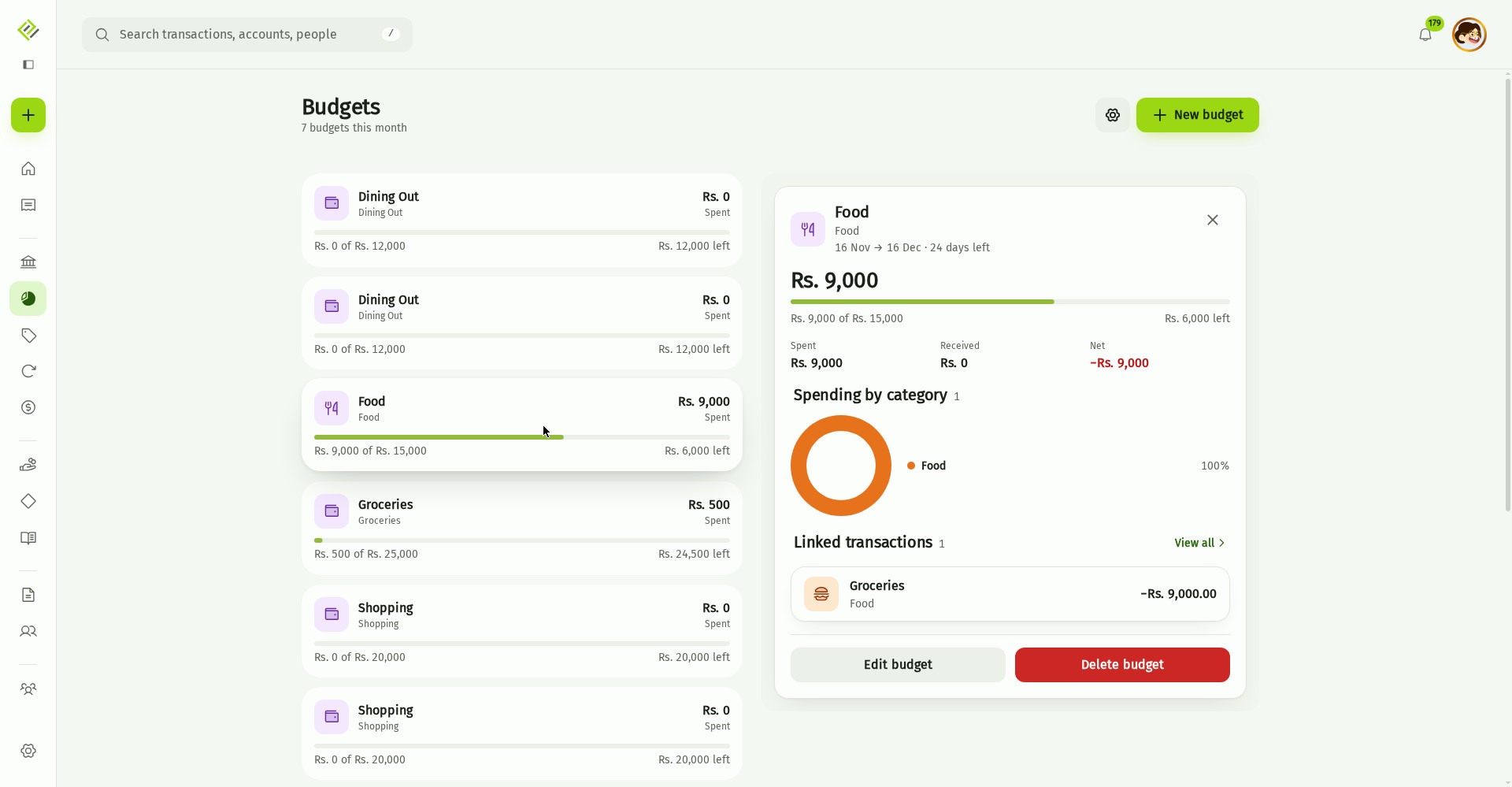
The Food budget below shows what that looks like in practice: Rs 9,000 spent of a Rs 15,000 limit, Rs 6,000 left, running 16 November to 16 December with 24 days left.
That screen is what keeps semester money alive: a limit, an amount spent, and an amount left, checked in seconds. A student who checks it once a week knows in October whether the money lasts to February.
Roommates: the split that settles itself
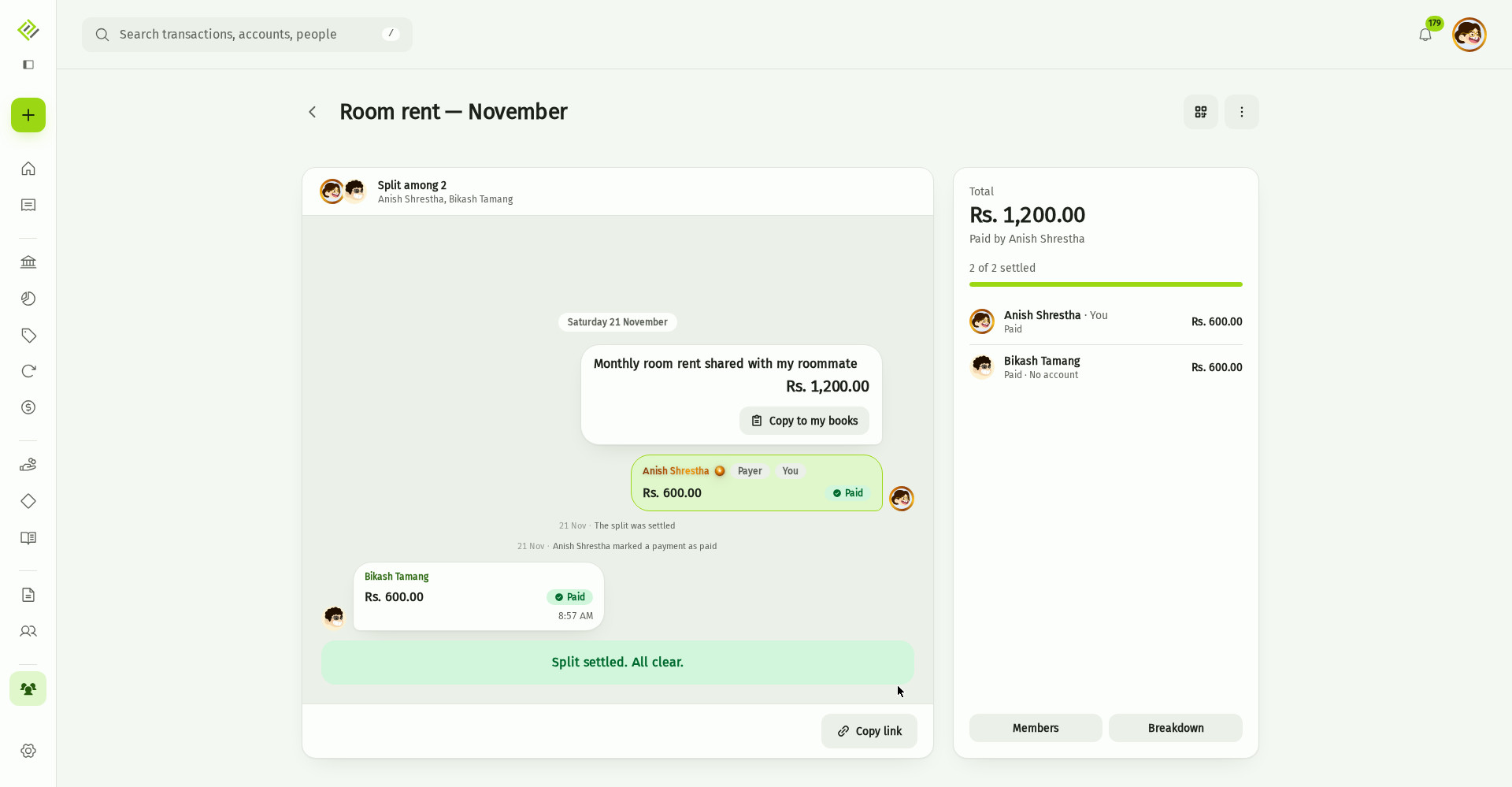
Rent is the biggest shared cost, and it is the one most likely to cause an argument. In Lipi, one split covers one bill. The payer counts as settled from creation, and settling is a tap on Mark paid, or Mark all as paid for the whole split.
The split below shows how it ends: "Room rent, November", Rs 1,200 in total, paid by Anish Shrestha and split equally with Bikash Tamang, Rs 600 each. Both marked paid, and the app shows "Split settled. All clear." with 2 of 2 settled.
The same shape covers internet, groceries and the shared streaming account. One split per bill, each person marked paid as they pay, and the list of open splits is the list of who still owes what. The full flow is in How to split expenses with friends in Lipi.
Lipi and the apps students usually try, side by side
The table judges one job: tracking a student's money. Free to start, no bank link, more than one currency, roommate splits, budgets that fit lump-sum income, and a price a student can pay are the criteria. Features that belong to full accounting software, like filing a tax return, are not scored here, because Lipi is a tracker and says so. Competitor facts are as of 21 November 2026.
| Feature | Lipi | YNAB | Spendee | Money Lover | Toshl | EveryDollar |
|---|---|---|---|---|---|---|
| Free to start | Yes | 12 months free for students, then paid | Yes, one wallet, one budget | Yes, ads, one wallet | Yes, with limits | Yes, manual entry |
| Works without a bank link | Yes, manual and offline | Yes, manual entry | Yes, manual entry | Yes, manual entry | Yes, manual entry | Yes, manual entry |
| More than one currency in one book | Yes | No, one currency per budget | Yes, per wallet | Yes | Yes, with conversion bugs reported | No |
| Roommate splits, free | Yes | No splits | Shared wallets need paid plan | Shared wallets exist, budgets limited | No splits | No splits |
| Student loan tracking | Yes, loans and EMI | No loan tracking | Loans counted as assets in reviews | No loan tracking | No loan tracking | No loan tracking |
| Budget for a lump sum | Yes, one-off over custom dates | Yes, monthly only | Yes, monthly only | Yes, monthly only | Yes, monthly only | Yes, monthly only |
| Receipt records | Yes, 5 smart scans a month free | No | Yes, with photos | Yes, with notes and photos | Yes, with photos on paid plans | No |
| Price after any free period | USD 3 a month, or USD 2 a month billed yearly (USD 24) | $109 a year | Plus $3.99 a month; Premium $7.99 a month | One-time $19.99; bank link $2.49 a month extra | Pro $2.99 a month | Premium $79.99 a year |
Lipi takes the overall verdict for students because it is the only app in the table that is free to start, holds more than one currency, splits with roommates for free, and tracks a student loan, all in the same book. YNAB has the strongest budgeting method in the group and its free year for students is a real help, but it has no splits, one currency per budget, and a $109 a year cliff when the free year ends. Money Lover is the cheapest paid option, a one-time $19.99, but its free tier is one wallet with ads and only one free recurring transaction. Toshl handles several currencies and is free to start, but its low-star reviews report conversion errors. Spendee and EveryDollar are solid trackers, but neither covers the roommate half of a student's money.
What it costs
Prices are each app's published rate as of 21 November 2026.
| App | Free plan | Paid price | What the free plan gives a student |
|---|---|---|---|
| Lipi | Yes | Premium USD 3 a month, or USD 2 a month billed yearly (USD 24) | Tracking, 3 active budgets, 2 accounts, splits free |
| YNAB | 12 months free for students | $109 a year | Full product for a year, then $14.99 a month or $109 a year |
| EveryDollar | Yes, manual entry | Premium $79.99 a year | Full zero-based budget by hand |
| Money Lover | Yes, ads, one wallet | Premium one-time $19.99 | One wallet, budgets, ads |
| Toshl | Yes, with limits | Pro $2.99 a month or $19.99 a year | Manual tracking, multi-currency |
| Spendee | Yes, one wallet, one budget | Plus $3.99 a month; Premium $7.99 a month | One cash wallet, one total budget |
| Wallet | Yes, manual tracking | Lifetime Premium $29.99 | Manual tracking, multi-currency |
| PocketGuard | 7-day trial only | Plus $74.99 a year | Trial only, no free plan |
| Monarch | No | Core $99.99 a year | 7-day trial only |
| Rocket Money | Yes | Premium $7 to $14 a month | Subscription tracking, spending insights |
A student who pays nothing for Lipi gets tracking, three budgets, two accounts and free splits. The same student in YNAB pays $109 a year once the free year ends, in Monarch $99.99 a year, and in PocketGuard $74.99 a year. Over five years, Lipi Premium is $120 billed yearly. YNAB at $109 a year is $545, or $436 for years two to five after the free first year. PocketGuard Plus is $374.95 over five years, EveryDollar Premium $399.95, Monarch $499.95.
The free-plan limit, stated plainly
Lipi's free plan holds 2 accounts and 3 active budgets. That fits a student with a cash account and one bank account, and three budgets for food, transport and fun, for example. It does not fit the full stack some roundups describe: cash plus checking plus a card plus a savings account is four accounts, and that needs Premium for the extra accounts. Premium lifts the cap, and it costs USD 3 a month, or USD 2 a month billed yearly (USD 24). This page does not pretend the free plan holds more than two accounts, because it does not.
The same honesty applies to the rest of the free plan. Splits are free, invoices and clients are free, and receipt scanning gives 5 smart scans a month free, with further receipts saving as attachments. Recurring and scheduled creation, the Bills radar, data export and statement import are Premium. A student who only needs tracking, budgets and splits can stay free.
Textbooks and receipts
Textbooks, course supplies and exam fees are the expenses a student most often needs to prove later, for a refund, a reimbursement, or a parent who wants to see where the money went. Lipi keeps the receipt with the entry: 5 smart scans a month are free, and after that a receipt photo saves as an attachment on the transaction. The scan reads the amount and the vendor from the photo, and the entry carries the category and a note, so the record is complete at the moment of spending instead of rebuilt in a rush later.
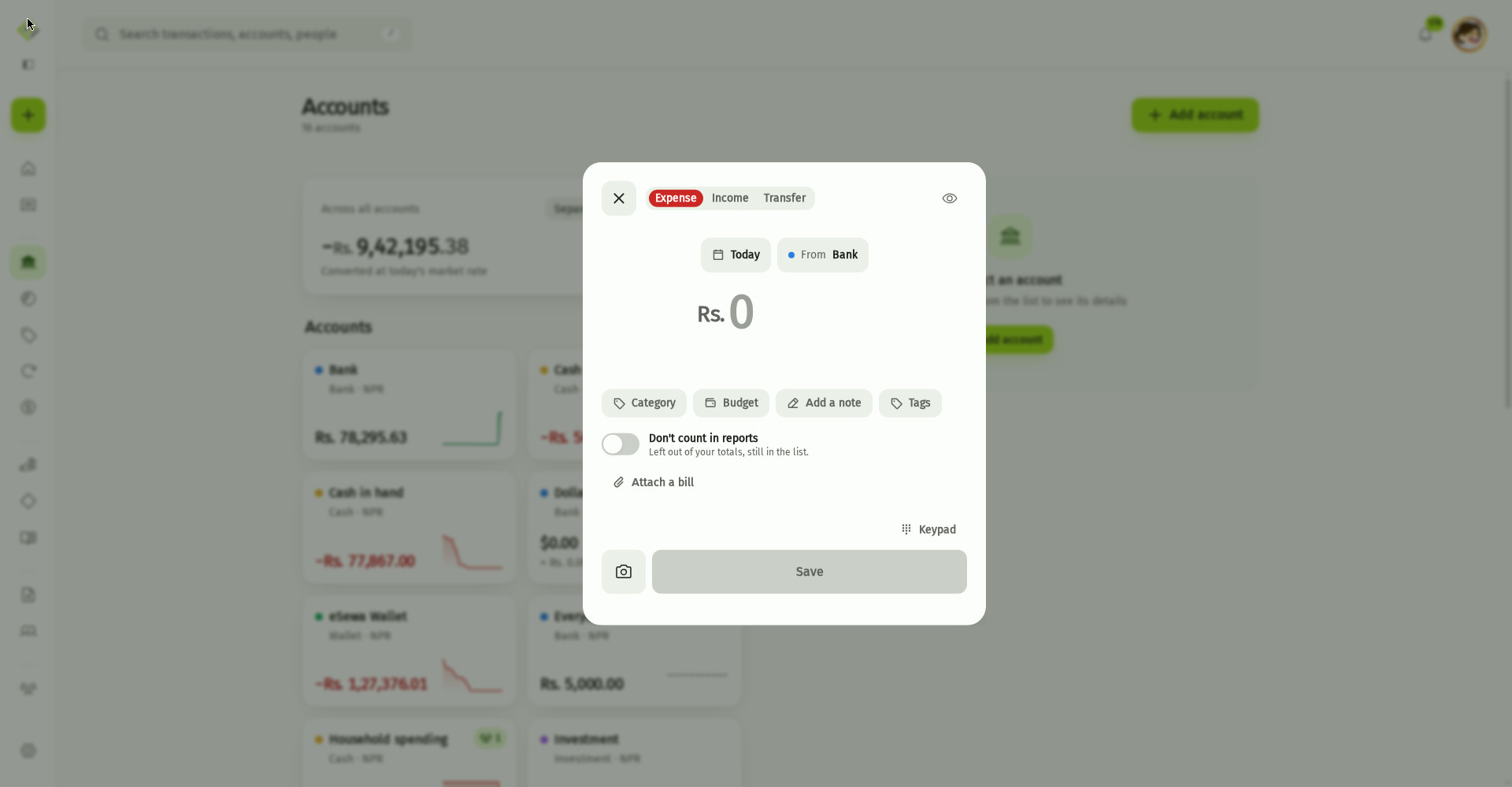
How to scan a receipt in Lipi shows the flow step by step, and How to run a monthly money routine for your household in Lipi covers the once-a-month review that catches the missing receipts before they matter.
What Lipi does not do
A page that only lists strengths is a brochure, so here is the other side, stated as plainly as the strengths.
Lipi does not link to a bank account or import transactions automatically, and it never will by design: manual entry is the trade for working offline and without a bank login. It does not service student loans or build a payoff schedule, though it does track loans and EMI, with prepayment. It does not estimate tax on part-time income or file a tax return. It does not track shares or investments, and it never presents them as a capability. It does not cancel subscriptions or negotiate bills for you, though it does record them as recurring expenses so you can see what they cost. And Lipi has no student discount of its own: Premium is USD 3 a month, or USD 2 a month billed yearly (USD 24) for everyone, which is the whole point, it is already priced for a student.
Those limits are acceptable for most students and disqualifying for a few. A student whose money is a lump sum, a part-time wage, a shared rent and a stack of small purchases needs a book that is always current, always in their pocket, and free at the point where the money is tightest. That is Lipi.
Questions students ask
What is the best expense tracker app for students?
The one that is free to start, works without a bank link, holds more than one currency, splits rent with roommates, and costs almost nothing when the free period ends. Lipi covers all five, with splits free and Premium at USD 3 a month, or USD 2 a month billed yearly (USD 24). YNAB has the strongest budgeting method and a free year for students, but no splits and a $109 a year cliff. Money Lover is the cheapest paid option but has one free recurring transaction.
Is YNAB free for students?
Yes, for 12 months, with proof of enrolment, and the full product is included. After that it costs $14.99 a month or $109 a year, with no permanent free tier. A student who starts with YNAB should plan for that cliff, and keep the budget in a form that survives moving to a free tracker.
Is PocketGuard worth it for students?
PocketGuard Plus costs $74.99 a year or $12.99 a month, with a 7-day trial and no free plan. There is no student discount. For a student budget, $74.99 a year buys the same tracking Lipi gives free, and the debt payoff plan is the one feature a student with a loan might miss, which Lipi covers only as loan and EMI tracking, not as a payoff schedule.
Is there a free expense tracker that does not need my bank login?
Yes. Lipi is manual and offline by design, with no bank link at all. EveryDollar's manual budget is free, Money Lover is free with ads and one wallet, and Spendee is free with one wallet and one budget. YNAB and Monarch have no free plan, and Rocket Money needs a bank link to do most of what it is for.
How do you budget with irregular income?
Budget only on money received, divide any lump sum by the number of months it must last before spending any of it, size the budgets to the average month, and keep the surplus of good months as a buffer for the lean ones. For a student, that means the aid disbursement divided by five, the allowance as it arrives, and the part-time pay as it lands.
How do students track expenses?
The system that survives is a short one: log each expense as it happens, keep the receipt with the entry, split shared costs at the moment they happen, and review once a week. A spreadsheet works until the entries pile up at the end of the month; an app works because the entry happens at the moment of spending. Expense tracker vs spreadsheet: which one actually keeps your money tracked works through that comparison in full, and Best expense tracker apps: 8 compared on price, currencies, gold, loans and splits puts Lipi against the rest of the field.
The short version
Student money is lump sums, part-time pay, shared rent and small purchases, and the tracker has to fit that shape for almost no money.
Open Lipi and set up your student book today. The semester budget, the roommate split and the receipt records are all in there, and they stay current because the entries take seconds.
Sources
- How to split expenses with friends in Lipi, Lipi (read 21 November 2026)
- How to scan a receipt in Lipi, Lipi (read 21 November 2026)
- How to run a monthly money routine for your household in Lipi, Lipi (read 21 November 2026)
- Expense tracker vs spreadsheet: which one actually keeps your money tracked, Lipi (read 21 November 2026)
- Best expense tracker apps: 8 compared on price, currencies, gold, loans and splits, Lipi (read 21 November 2026)
Keep reading
Guide
Free alternative to EveryDollar: Lipi for zero-based budgeting without the locked months
Lipi is the free alternative to EveryDollar for zero-based budgeting without locked months: past months stay editable, budgets and splits are free, and Premium costs USD 3 a month or USD 2 a month billed yearly (USD 24).
20 min read
Guide
Free alternative to Monarch: Lipi for manual tracking without the subscription
Lipi is the free alternative to Monarch for people who want manual tracking without a subscription: free to start, budgets and splits free, and accounts in more than one currency in one book. Monarch Core costs $99.99 a year after a 7-day trial, with no free plan.
18 min read2 views
Guide
Free alternative to Toshl: Lipi for multi-currency tracking that converts properly
Lipi is the free alternative to Toshl: multi-currency tracking that converts at the real rate, budgets and splits free, and no subscription to see your own money. Premium costs USD 3 a month, or USD 2 a month billed yearly (USD 24).
17 min read
Guide
Free alternative to PocketGuard: Lipi for manual tracking without the subscription
Lipi is the free alternative to PocketGuard: manual tracking with no bank link, budgets and splits free, and no subscription to see your own money. Premium costs USD 3 a month, or USD 2 a month billed yearly (USD 24).
18 min read1 view