Guide
Expense tracker app for shopkeepers: Lipi for daily sales, customer credit and keeping shop money apart
Lipi is the expense tracker app for shopkeepers: daily cash sales logged offline at the counter, per-customer amounts owed through free invoices and clients, and shop money kept apart from household money. Premium costs USD 3 a month, or USD 2 a month billed yearly (USD 24).
By Bikram LamaPublished Updated 19 min read1 view
Lipi is the expense tracker app for shopkeepers: daily sales logged offline, customer credit tracked per person, and shop money kept apart from household money.
A shopkeeper's money has four parts that most budget apps treat as one problem. There is the daily sale: cash in the till, small amounts, many times a day. There is the credit: customers who take goods now and pay later, each with a running balance. There is the stock: supplier payments and purchases that have to come out of the same till. And there is the household: the shop's money and the family's money leaving the same drawer. A tracker built for a monthly salary handles none of that well.
Open Lipi and set up your shop book today. Tracking, invoices and clients are free, and the setup takes an evening.
Why shop money breaks a normal budget app
The first problem is speed at the counter. A sale has to be logged in seconds, while the customer waits, often with no signal. An app that loads slowly, freezes, or needs a connection to save an entry stops the shop. Offline entry is not a feature for a shopkeeper, it is the whole job.
The second problem is credit. In a shop, credit is a daily fact, not a loan product: regular customers take goods and pay at the end of the week or the month. The tracker has to show, per customer, what is still owed, and the total still to collect. A tracker that only shows this month's total spending cannot answer the only question that matters at closing time: who owes what.
The third problem is separation. The same drawer holds the day's takings, the supplier payment due tomorrow, and the money for groceries at home. A tracker with one wallet and one budget cannot keep those apart, and a tracker that ties budgets to a single payment source cannot hold a shop that pays suppliers in cash, by card and by bank.
The fourth problem is the phone. A shopkeeper runs the shop on one phone and checks the books on another at home. An app that charges twice to keep both phones ad-free, or loses the ledger when the phone changes, is not a shop app at all.
What shopkeepers find when they try the usual apps
The low-star reviews of the apps shopkeepers usually try first repeat the same complaints. They are worth reading before you pick one, because the pattern says more than any single review.
The first complaint is an app that stops working after an update. A Google Play review of Spendee from Prunaru Cosmin, dated 22 October 2026, reads:
"Used to be good. After the update which changed the UI it became unusable, transactions not loading, very slow loading of all UI elements. Not worth it now"
Another Spendee reviewer, Brooke Geng, dated 18 September 2026, is specific about where it hurts:
"The latest update introduced severe lag when typing in transaction amounts during new entries, making basic tracking frustrating."
Lag on the number pad while a customer waits is not a minor bug in a shop. It is the sale not being logged at all.
The second complaint is data loss. A Trustpilot review of Spendee from Indra reads:
"Spendee deleted years of data, and offers no compensation except 3 months free subscription. I'm livid!"
Another Spendee reviewer, Cathy Brown, also on Trustpilot, writes:
"I purchased the premium account several months ago. Even with their help I was never able to download the data from one of my bank accounts. I entered quite a bit manually. After getting it set up and using it for a bit, all of a sudden my data was gone. Others frequently also mentioned this issue. Stay away from this ..."
For a shopkeeper, years of data is the ledger. Losing it means losing the record of who owes what, which is the shop's money.
The third complaint is a paywall on a feature that used to be free. A Google Play review of Money Lover from Emily Meeks, dated 27 September 2021, says:
"I have enjoyed using this app to track my money for years, but recently I switched to a new phone. When trying to restore my recurring transactions, I found that I now can only have 1 recurring transaction without paying $35 for a premium account. That's pretty scummy for a feature that was once free and is standard in most money tracker apps. I will be switching to a new app to track my expenditures."
A shop runs on repeats: rent, supplier payments, the same orders every week. One free recurring transaction does not cover a shop's month.
The fourth complaint is a budget tied to one payment source. An App Store review of Money Lover from Egornat reads:
"...the developer thinks you only use ONE source to pay for the things you've decided to track by using 'budgets'. So if pay for your food not only exclusively in cash or not exclusively by a specific credit card — MoneyLover is 100% useless for you if you want to keep to a budget."
A shop pays suppliers in cash, by card and by bank, sometimes in the same week. A budget that only counts one of those cannot hold a shop's spending.
And the fifth complaint is currency going wrong across hundreds of entries. A Trustpilot review of Wallet by BudgetBakers, dated 3 September 2025, reads:
"no Bank sync is working anylonger. An account in euros has changed in CHF and i can not correct it unless to manually retype all the 481 entries!"
A shop with hundreds of small sales cannot retype its month. A conversion error that touches every entry is not a small defect, it is the whole book gone wrong.
None of these apps is a bad app. The pattern in the low-star reviews is narrower than that: slow entry at the counter, lost records, a paywall on repeats, budgets tied to one payment source, and a currency error across hundreds of entries. Those are the exact points where a shop's book is most fragile, and Lipi is built around the opposite choices: manual entry that works offline, invoices and clients free, budgets that span every account, and Premium at USD 3 a month, or USD 2 a month billed yearly (USD 24).
A shop week in Lipi, with real numbers
Take a small shop in a normal week. Daily sales average Rs 4,500, so the week brings in Rs 31,500. Of that, Rs 6,000 is credit given to three regular customers, and Rs 25,500 arrives as cash. The stock purchase for the week is Rs 18,000. Other shop costs, electricity share and transport, come to Rs 2,200. Household spending from the same drawer is Rs 4,800.
The week in one line: Rs 25,500 of cash received, minus Rs 18,000 of stock, minus Rs 2,200 of shop costs, minus Rs 4,800 of household spending, leaves Rs 500 in cash. And Rs 6,000 is still owed by customers. That is the number that decides whether the next stock order can be paid, and it is only visible because the credit was recorded per customer instead of counted as cash.
In Lipi that week looks like this. Each day's sales are logged as they happen, in cash, offline, at the counter. The Rs 6,000 of credit sits as invoices against three client records, each showing what that customer still owes. The Rs 18,000 stock purchase is an expense in its own category, so it never mixes with groceries. The household Rs 4,800 sits in a separate budget, so the shop's profit is visible without the family's spending inside it.
Who owes what: the client record
This is the part of the job that decides whether a tracker works for a shop at all. In Lipi, each customer is a client, and each invoice sits against the client with its amount and its status. The client record shows a running total of what is still owed.
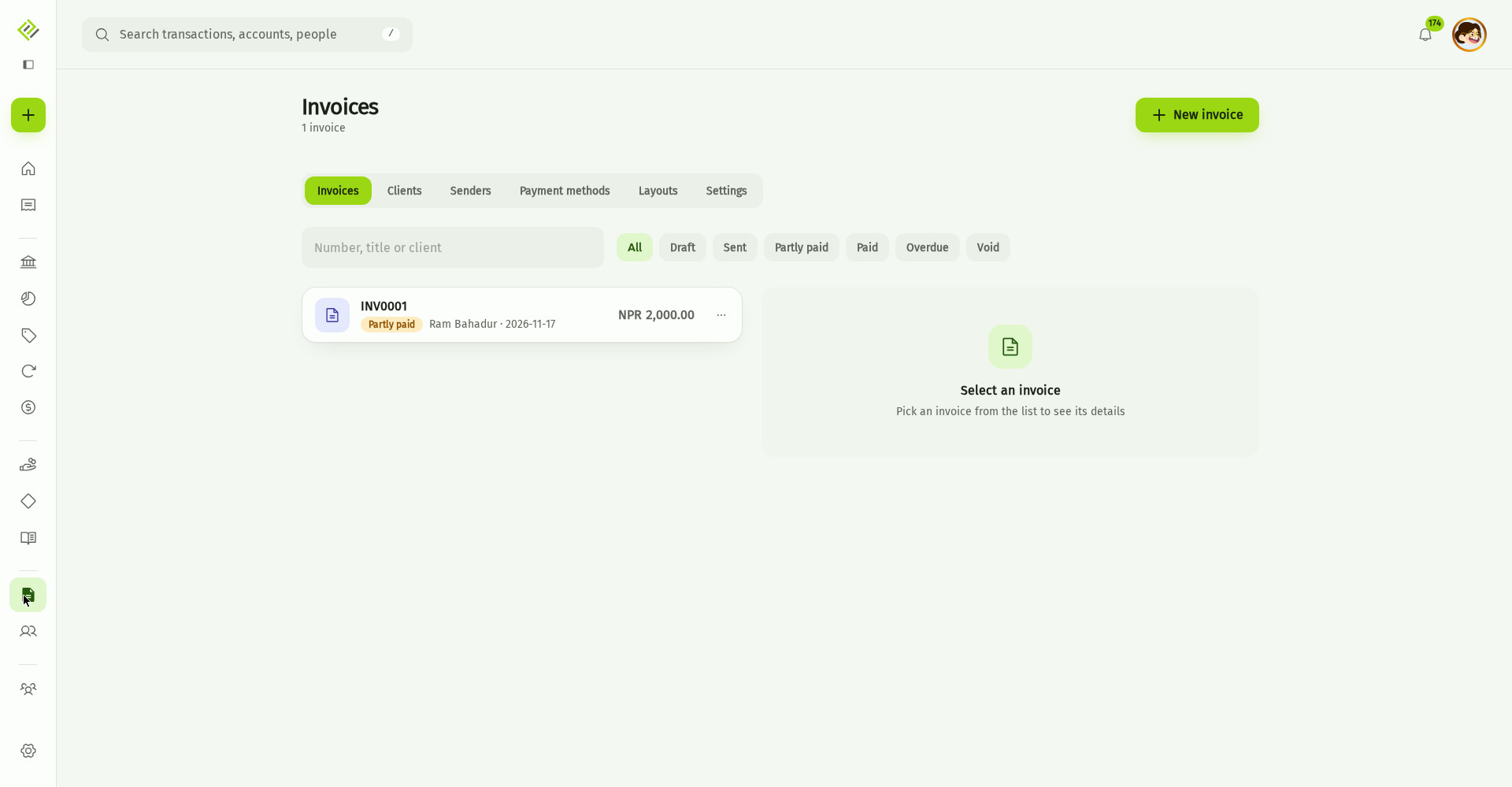
The client Ram Bahadur shows "Still owed NPR 2,000.00", with "3600.00 invoiced · 1600.00 paid (NPR)" underneath. One invoice, INV0001, is partly paid at NPR 3,600.00, and one payment of NPR 1,600.00 was received on 17 November 2026. The remaining NPR 2,000.00 is the amount still to collect.
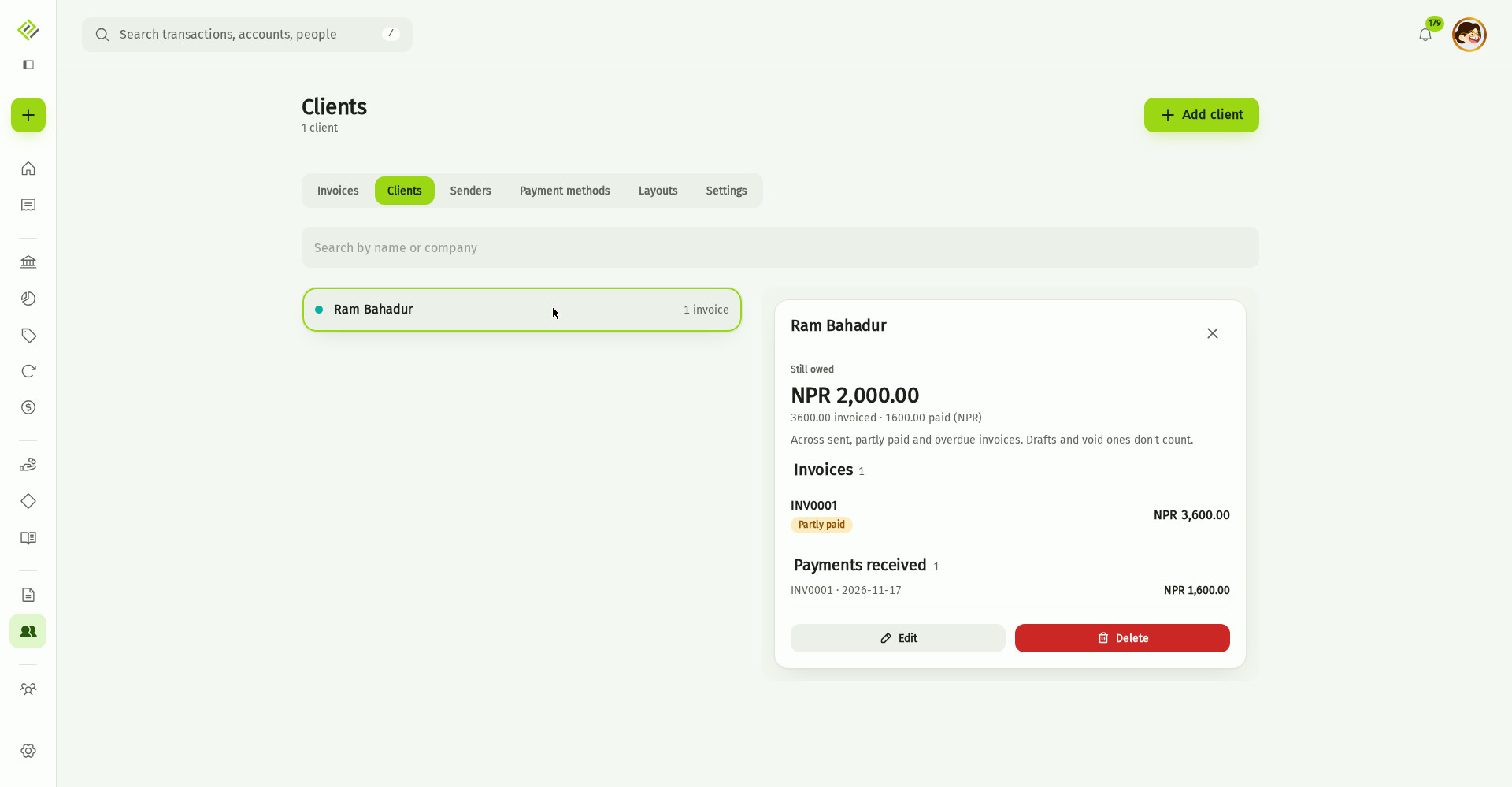
The invoices list shows the same picture across all customers: each invoice with its number, its status, the client, the date, and the amount still owed. INV0001 reads "Partly paid", Ram Bahadur, 17 November 2026, NPR 2,000.00. The status filters run across All, Draft, Sent, Partly paid, Paid, Overdue and Void, so the overdue list is one tap away at closing time.
Invoices and clients have been free for everyone since the 3 November 2026 ship. There is no trial, no paywall, and no limit on the number of clients. Marking an invoice paid records the income at the same time, so the book never double counts, and a part payment leaves the rest still owed, which is how shop credit actually works.
Shop money apart from household money
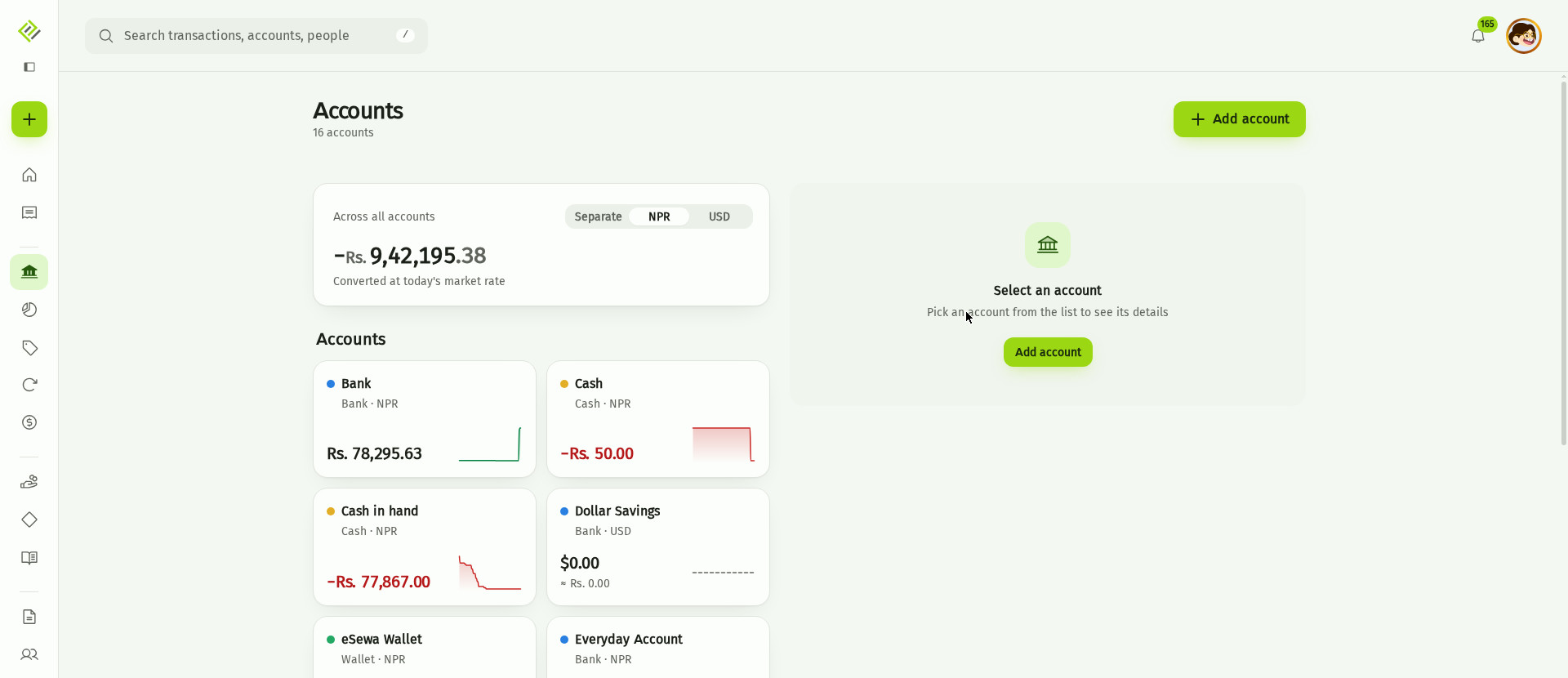
The question shopkeepers ask most is how to separate business and personal spending. The short answer is to keep them in separate accounts and never pay personal bills from business funds. Lipi does that with accounts and budgets: the cash drawer, the bank account and the household spending each sit in their own account, and the shop's budgets cover stock, rent and shop costs while the household budget covers groceries and home spending.
The honest limit sits here, and it is worth stating plainly. Lipi's free plan holds 2 accounts and 3 active budgets. A shopkeeper who wants a cash drawer, a bank account and a supplier account at once exceeds the free cap and needs Premium for the extra accounts. Premium lifts the cap, and it costs USD 3 a month, or USD 2 a month billed yearly (USD 24). This page does not pretend the free plan holds several shop accounts side by side, because it does not.
What the free plan does hold is enough to start: two accounts, three budgets, free invoices and clients, free splits, and manual entry that works offline. A shopkeeper who starts with a cash drawer and a bank account, and budgets for stock, shop costs and household spending, can run the shop on the free plan and add the supplier account on Premium when the shop grows.
Lipi and the apps shopkeepers usually try, side by side
The table judges one job: keeping a shop's book. Free to start, offline entry at the counter, per-customer amounts owed, shop money kept apart from household money, more than one currency, and a price a small shop can pay are the criteria. Features that belong to full accounting software, like filing a tax return, or to a till, like ringing up itemised sales, are not scored here, because Lipi is a tracker and says so. Competitor facts are as of 21 November 2026.
| Feature | Lipi | Money Manager | Spendee | Money Lover | Toshl | Wallet |
|---|---|---|---|---|---|---|
| Free to start | Yes | Yes, with ads | Yes, one wallet, one budget | Yes, ads, one wallet | Yes, with limits | Yes, manual tracking |
| Works offline at the counter | Yes, manual and offline | Yes, manual entry | Needs a connection for most features | Yes, manual entry | Yes, manual entry | Yes, manual entry |
| Per-customer amounts owed | Yes, free invoices and clients | No client list | No client list | No client list | No client list | No client list |
| Shop money apart from household | Yes, accounts and budgets | Yes, double-entry | Yes, per wallet | Yes, per wallet | Yes, per account | Yes, per wallet |
| Budgets across every account | Yes | Yes | Yes, one total budget free | No, one payment source per budget | Yes | Yes |
| More than one currency in one book | Yes | Yes | Yes, per wallet | Yes | Yes, with conversion bugs reported | Yes |
| Free plan | Yes | Yes, ads, 15 assets | Yes, one wallet, one budget | Yes, ads, one wallet | Yes, with limits | Yes, manual tracking |
| Price of the paid plan | USD 3 a month, or USD 2 a month billed yearly (USD 24) | Remove Ads $5.99 one-time; Sync $2.49 a month | Plus $3.99 a month; Premium $7.99 a month | One-time $19.99; bank link $2.49 a month extra | Pro $2.99 a month | Lifetime $29.99 |
Lipi takes the overall verdict for shopkeepers because it is the only app in the table that tracks what each customer owes, for free, in the same book as the daily sales. Money Manager is the closest rival and keeps one honest strength: double-entry bookkeeping, business transactions and a PC editor, which Lipi does not have. Money Lover is the cheapest paid option, a one-time $19.99, but its free tier is one wallet with ads and only one free recurring transaction. Toshl handles several currencies and is free to start, but its low-star reviews report conversion errors. Spendee and Wallet are solid trackers, but neither tracks clients or invoices, which is the shopkeeper's core job.
What it costs
Prices are each app's published rate as of 21 November 2026.
| App | Free plan | Paid price | What the free plan gives a shopkeeper |
|---|---|---|---|
| Lipi | Yes | Premium USD 3 a month, or USD 2 a month billed yearly (USD 24) | Tracking, 3 active budgets, 2 accounts, invoices and clients free |
| Money Manager | Yes, with ads | Remove Ads $5.99 one-time; Sync $2.49 a month | 15 assets, manual tracking, ads |
| EveryDollar | Yes, manual entry | Premium $79.99 a year | Full zero-based budget by hand |
| Money Lover | Yes, ads, one wallet | Premium one-time $19.99 | One wallet, budgets, ads |
| Toshl | Yes, with limits | Pro $2.99 a month or $19.99 a year | Manual tracking, multi-currency |
| Spendee | Yes, one wallet, one budget | Plus $3.99 a month; Premium $7.99 a month | One cash wallet, one total budget |
| Wallet | Yes, manual tracking | Lifetime Premium $29.99 | Manual tracking, multi-currency |
| YNAB | No | $109 a year | 34-day trial only |
| Monarch | No | Core $99.99 a year | 7-day trial only |
| PocketGuard | 7-day trial only | Plus $74.99 a year | Trial only, no free plan |
A shopkeeper who pays nothing for Lipi gets tracking, three budgets, two accounts, and free invoices and clients. The same shopkeeper in YNAB pays $109 a year, in Monarch $99.99 a year, and in PocketGuard $74.99 a year, and none of them records what a customer owes. Over five years, Lipi Premium is $120 billed yearly. YNAB at $109 a year is $545. PocketGuard Plus is $374.95 over five years, EveryDollar Premium $399.95, Monarch $499.95, Spendee Premium $224.95. Money Lover Premium at a one-time $19.99 is cheaper than Lipi Premium over five years, and Wallet's lifetime $29.99 is cheaper too, and both are kept here as their honest strengths.
Daily sales, logged in seconds
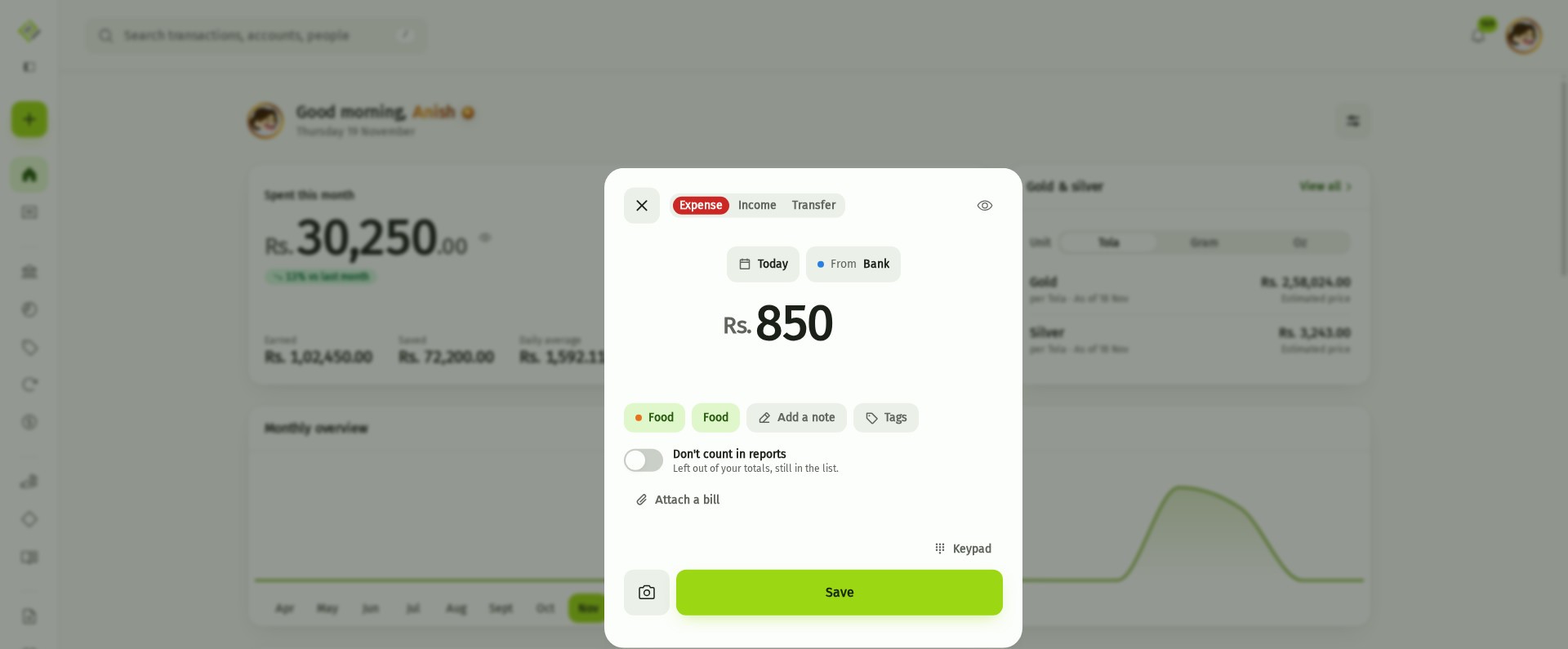
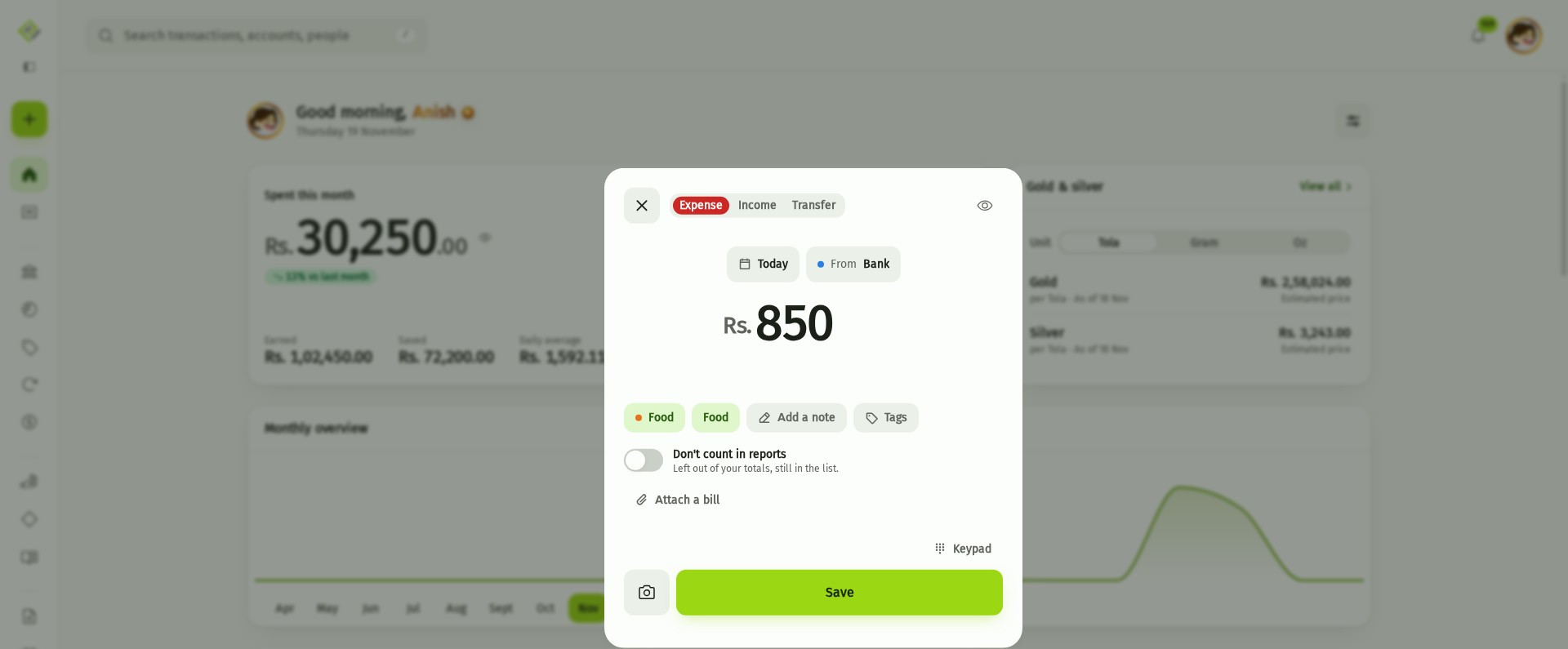
A sale that is not logged at the moment it happens is usually not logged at all, and a week of unlogged sales is a week with no profit figure. Lipi's entry is a tap on the plus button, an amount, a category, and save. The dialog shows Expense, Income and Transfer, the date, the account, and rows for category, budget, a note and tags, with a camera button to scan a bill and a row to attach one.
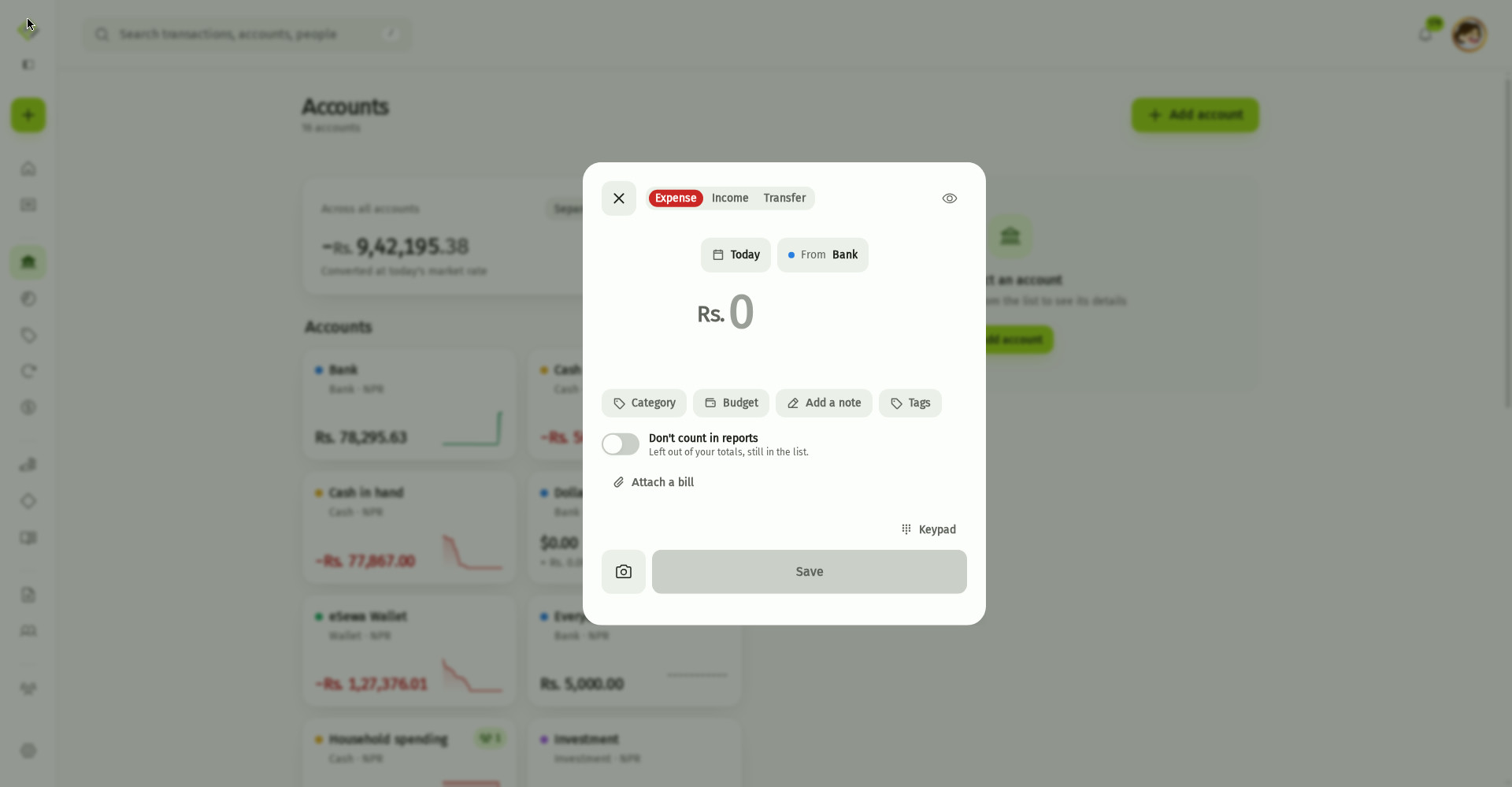
The scan reads the amount and the vendor from a photo of a supplier bill, and the entry carries the category and a note, so the record is complete at the moment of spending. 5 smart scans a month are free, and after that a receipt photo saves as an attachment on the transaction. How to scan a receipt in Lipi shows the flow step by step.
For a shop that takes two currencies, Lipi holds accounts in more than one currency, with each balance kept in its own currency. A payment in dollars lands in the dollar account, a payment in the local currency lands in the local account, and the spending account holds the currency the rent is paid in. Toshl's low-star reviews show what goes wrong when a conversion is wrong: 123 euros recorded as 123 dollars, and every total after it wrong by the same margin.
Expense tracker app for freelancers: Lipi for invoices, clients and irregular income covers the same invoices and clients from a freelancer's side, and Best expense tracker apps: 8 compared on price, currencies, gold, loans and splits puts Lipi against the rest of the field.
What Lipi does not do
A page that only lists strengths is a brochure, so here is the other side, stated as plainly as the strengths.
Lipi does not manage stock: no quantities, no low-stock alerts, no cost price or selling price per item, and no profit per item. It is not a till: it does not ring up itemised sales, scan barcodes, or take payment at the counter. It does not send reminders to customers about overdue credit, though it does show exactly who owes what, so the reminder list is one tap away. It does not calculate or file tax. It does not do full double-entry accounting or produce a profit-and-loss report, and it never presents itself as accounting software. It does not link to a bank account or record digital payments automatically, and it never will by design: manual entry is the trade for working offline and without a bank login. It does not track shares or investments. And it does not collect payments from customers: it records what is owed and what was paid, but the money itself changes hands outside the app.
Those limits are acceptable for most small shops and disqualifying for a few. A shopkeeper whose day is cash sales, credit to regulars, supplier payments and a household to feed needs a book that is always current, always in their pocket, and free at the point where the margins are thinnest. That is Lipi. A shopkeeper who needs to know what is running low on the shelf needs stock software beside it, and this page says so rather than pretending otherwise.
Questions shopkeepers ask
What is the best app to track shop expenses?
The one that logs daily sales offline, shows what each customer owes, keeps shop money apart from household money, and costs almost nothing. Lipi covers all four, with invoices and clients free and Premium at USD 3 a month, or USD 2 a month billed yearly (USD 24). Money Manager is the closest rival, with double-entry bookkeeping and a PC editor, but it has no client list. Money Lover is the cheapest paid option but has one free recurring transaction and budgets tied to one payment source.
How do shopkeepers track daily sales and expenses?
The system that survives is a short one: log each sale as it happens, record credit against the customer's name the same day, log the stock purchase in its own category, and close the day by checking cash against the book. A paper register works until the entries pile up at the end of the month; an app works because the entry happens at the counter, and the customer balances stay current without a second book.
How do I separate business and personal expenses?
Keep them in separate accounts and never pay personal bills from business funds. In Lipi that means a cash drawer and a bank account for the shop, a separate account for household spending, and budgets that cover stock, shop costs and household spending separately. The free plan holds 2 accounts, so a shopkeeper who needs a third account for a supplier takes Premium, which lifts the cap.
What is the best app to track udharo?
A khata app is built for credit ledgers, with reminders and part-payments, and a shopkeeper who wants automatic reminders should look at one. For a tracker that also holds the daily sales, the stock purchases and the household budget, Lipi tracks credit through free invoices and clients: each customer shows a running total still owed, each invoice shows its status, and part payments leave the rest still owed. What Lipi does not do is send the reminder itself.
Is there a free expense tracker for shopkeepers?
Yes. Lipi's tracking, 3 active budgets, 2 accounts, invoices, clients and splits are free, with Premium at USD 3 a month, or USD 2 a month billed yearly (USD 24). EveryDollar's manual budget is free, Money Lover is free with ads and one wallet, and Spendee is free with one wallet and one budget. YNAB and Monarch have no free plan, and Rocket Money needs a bank link to do most of what it is for.
Can two people sell at the same time?
Lipi has shared accounts, so two people running one shop can work from the same books. What Lipi does not have is staff roles with permissions, so both people see the same books. A shop that needs cashier roles, where staff see sales but not profit, needs a till app with staff permissions, and Lipi does not claim to be one.
The short version
A shop needs daily sales logged fast, credit tracked per customer, stock kept apart from household spending, and a price the margins can carry.
Open Lipi and set up your shop book today. The invoices, the client balances and the daily sales are all in there, and they stay current because the entries take seconds.
Sources
- How to scan a receipt in Lipi, Lipi (read 21 November 2026)
- Expense tracker app for freelancers: Lipi for invoices, clients and irregular income, Lipi (read 21 November 2026)
- Best expense tracker apps: 8 compared on price, currencies, gold, loans and splits, Lipi (read 21 November 2026)
Keep reading
Guide
Expense tracker app for freelancers: Lipi for invoices, clients and irregular income
Lipi is the expense tracker app for freelancers who invoice clients and live on irregular income: free invoices and a free client list, multi-currency accounts, budgets built on money actually received, and receipt records for tax time. Premium costs USD 3 a month, or USD 2 a month billed yearly (USD 24).
18 min read3 views
Guide
Free alternative to EveryDollar: Lipi for zero-based budgeting without the locked months
Lipi is the free alternative to EveryDollar for zero-based budgeting without locked months: past months stay editable, budgets and splits are free, and Premium costs USD 3 a month or USD 2 a month billed yearly (USD 24).
20 min read
Guide
Free alternative to Monarch: Lipi for manual tracking without the subscription
Lipi is the free alternative to Monarch for people who want manual tracking without a subscription: free to start, budgets and splits free, and accounts in more than one currency in one book. Monarch Core costs $99.99 a year after a 7-day trial, with no free plan.
18 min read2 views
Guide
How to track expenses in multiple currencies
Give every currency its own account, and let one total convert at the day's rate. This page shows the method, the conversion bugs other apps ship with, a worked example at today's live rate, and what each app costs. Free to start with 2 accounts and 3 budgets. Premium USD 3 a month, or USD 2 a month billed yearly (USD 24).
18 min read