Guide
Expense tracker app for couples: Lipi for shared budgets and splits
Lipi is the expense tracker app for couples who share bills but keep their own money: shared accounts and splits free, shared budgets, multi-currency accounts and manual offline entry in one book. Premium costs USD 3 a month, or USD 2 a month billed yearly (USD 24).
By Bikram LamaPublished Updated 16 min read1 view
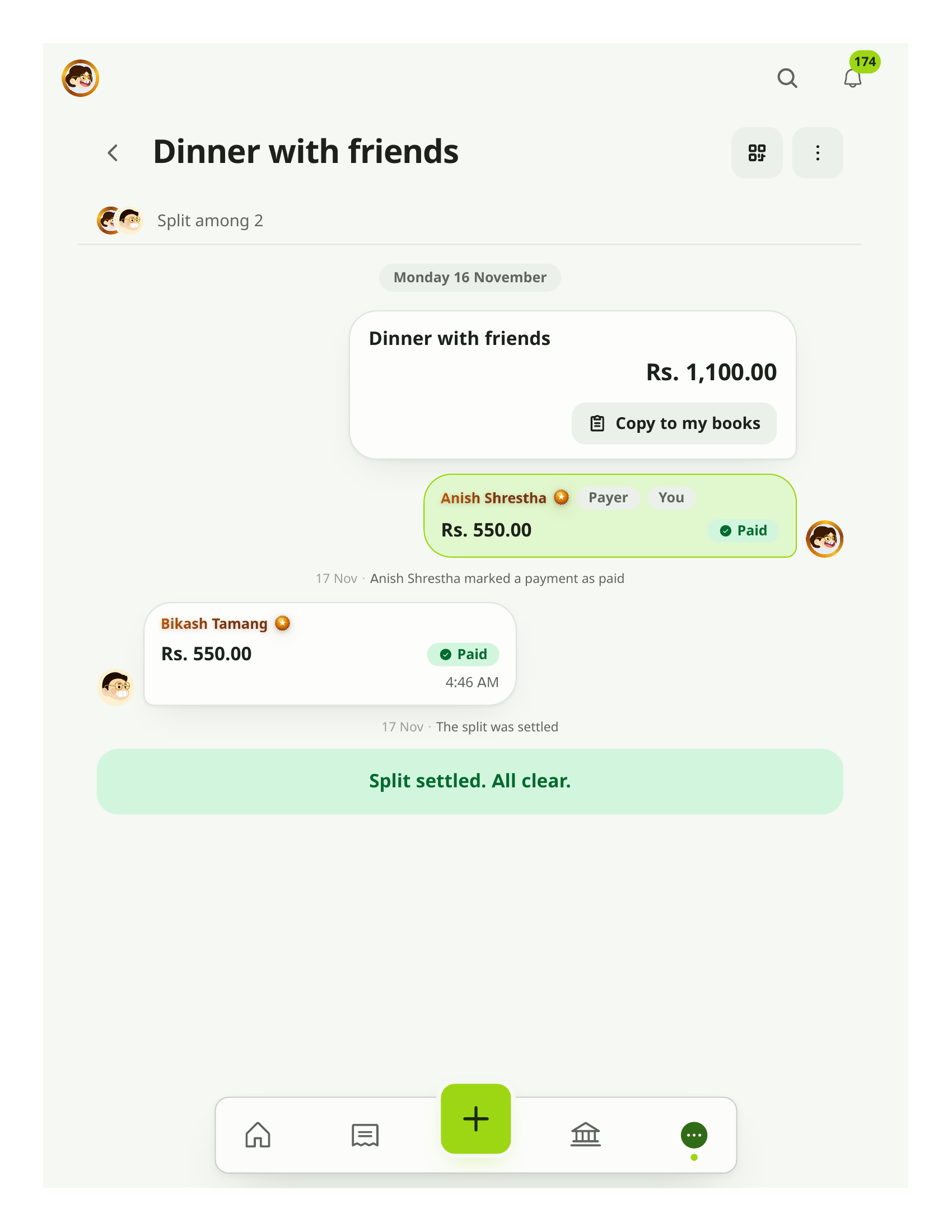
Lipi is the expense tracker app for couples that shares budgets and splits free.
Two people, one shared book for the bills you split, and your own money stays yours. A shared account lets both of you record into the same accounts, a split settles each shared bill, and a shared budget caps the month you plan together. No bank login, no paywall around sharing. If the household is a whole family, with children or an allowance to track, the families guide covers shared budgets, splits and allowance for the household.
Open Lipi and set up one shared account with your partner today. Log the first shared bill together and the split does the rest of the maths.
Why couples go looking for a new tracker
Most couples argue about who paid for what, whether the other person saw it, and why the app charges extra for the one feature two people need: sharing. The low-star reviews of the big trackers keep landing on the same three complaints.
First, sharing costs money. Spendee's own pricing page puts shared wallets on its paid tiers. The free plan gives one cash wallet and one budget, and sharing starts on Plus at $3.99 a month or $27.99 a year on App Store prices, checked 20 November 2026. Wallet by BudgetBakers does the same: Group Sharing, the feature that lets a household share accounts and savings goals, is Premium only, at about 4.49 euros a month. The free plan covers one person's tracking, and the couple pays before they share anything.
Second, the app that does share often cannot say who owes whom. YNAB Together puts up to six people on one subscription, which sounds like the answer, and the price is $14.99 a month or $109 a year with no free plan. But the group manager sees every plan the members create, and YNAB's own pages describe no way to split a cost between two people. One partner pays for the groceries, the other partner's plan never hears about it, and who owes whom gets worked out outside the app. A 1-star App Store review from October 2026 puts the other problem plainly:
"This app used to be great for tracking spending and making a budget but it now takes 12-24 hours to sync transactions."
A 4-star review from September 2026 is shorter, and it is the one couples quote most:
"I really like YNAB but I think it's too expensive."
Third, the shared record itself breaks. A 1-star Trustpilot review of Spendee reads:
"Spendee deleted years of data, and offers no compensation except 3 months free subscription. I'm livid!"
Another 1-star Trustpilot review, from a paying customer, says the same thing in slower motion:
"I purchased the premium account several months ago. Even with their help I was never able to download the data from one of my bank accounts. I entered quite a bit manually. After getting it set up and using it for a bit, all of a sudden my data was gone. Others frequently also mentioned this issue. Stay away from this ..."
A 1-star Google Play review from a three-year Spendee user asks the team to read its own reviews, then describes an app that became impossible to use after the redesign, with freezes across the app. Money Lover users hit a different wall: the app has shared wallets, but a Google Play review from 27 August 2026 asks for the feature that is still missing:
"Shared card expense splitting so others' items aren't counted in my budget, plus a 'Pending Reimbursement' tag in the same entry."
One partner pays on a shared card, the whole charge lands in that partner's budget, and there is no way to split it off. Simplifi has the bluntest version of the problem: it has no way to split a bill between two people at all, so the whole charge stays in the payer's budget.
Lipi answers all three directly. Sharing is free, not a paid tier. A split says who owes whom on every shared bill. And the record is typed by you, on your device, with no bank feed to break and no redesign in the way of the entry screen.
Lipi and the rest, on the couples job
The table scores the job a couple actually hires the app for: both people see the shared money, each shared bill settles, the free plan covers two people, and the price stays small. Competitor facts are from their own pricing pages and listings, checked 20 November 2026 unless stated.
| Feature | Lipi | Spendee | YNAB | Wallet by BudgetBakers | Money Lover | Monarch | Simplifi | PocketGuard | EveryDollar |
|---|---|---|---|---|---|---|---|---|---|
| Shared account or wallet | Yes, free | Shared wallets, paid tiers only | Shared plans under YNAB Together | Group Sharing, Premium only | Shared wallets | Shared household dashboard | Shares with one other person, own login | No, same login shared | Spouse sharing (Household), separate logins |
| Split one bill and see who owes whom | Yes, free, one bill per split | Shared wallet shows who paid | No shared-cost split described | Shares accounts, no split breakdown described | No, reviewers ask for shared card splitting | Owner labels, one shared budget | No | No | No |
| Partner records from their own phone | Yes, shared account | Yes, on a paid plan | Yes, own login under one subscription | Yes, on Premium | Yes, shared wallet | Yes, own login | Yes, own login for one other person | Yes, same login on each phone | Yes, separate logins |
| Free plan covers a couple | Yes, 2 accounts and 3 active budgets | No, one cash wallet and one budget | No free plan | Basic personal tracking only | One wallet, with ads | No free plan, 7-day trial | Trial only | No free plan, 7-day trial | Free plan is manual entry only |
| More than one currency in one book | Yes, accounts in different currencies | Yes, per wallet | No, one currency per plan | Yes, per account, 150 plus currencies | Yes | Yes | Yes | Yes | No |
| Bank login required | Never | Asked for on Premium | Asked for, for automatic import | Asked for on Premium | Asked for on Linked Wallet | Asked for | Asked for | Asked for | Asked for on Premium |
| Works offline | Yes, manual entry | Manual entry works offline | Manual entry works offline | Manual entry works offline | Manual entry works offline | No, built around linked accounts | No, built around linked accounts | No, built around linked accounts | Manual entry works offline |
Lipi comes first overall on this job. It is the only app in the table where sharing, splitting and the settle-up balance are all free, where the free plan holds two accounts side by side, and where no bank login is ever asked for. The honest lines for the rest: YNAB's method genuinely changes how people budget, and its one subscription covering six people is good value if both partners want the method. Monarch gives each partner their own login with no shared password, which is the cleanest household setup among the bank-linked apps. Money Lover's Premium is a one-time $19.99, which is genuinely cheap against every subscription in the table. None of that changes the verdict on the couples job itself: the shared bill still needs a split, and only Lipi gives you one free.
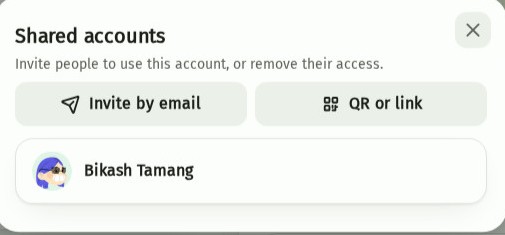
What sharing looks like in Lipi
Lipi shares in two ways, and both are free. Pick the one that matches how you actually run money together.
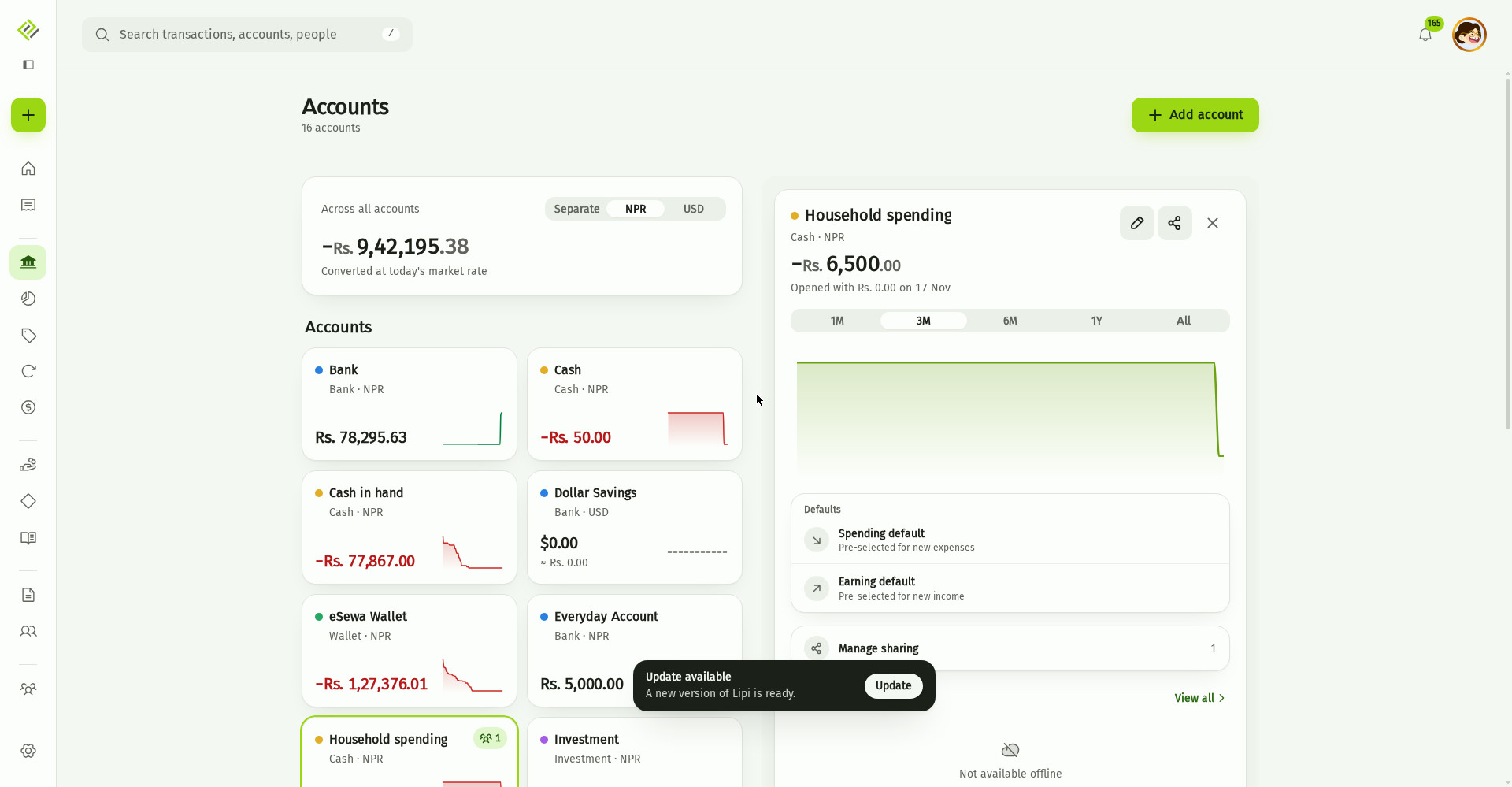
A shared account is for the money you pool. Both of you record into the same accounts, so a partner's grocery run lands in the same book as yours without passing one phone back and forth. Set a shared budget on it and the month has one cap you both watch. The guide to sharing an account walks through the setup.
A split is for the bills you share while keeping your own money separate, which is the far more common case for couples. One partner pays the rent, the other pays the groceries, and the split keeps the score. One split covers one bill: add the people on it, enter the total and who paid, set equal or custom shares, and the breakdown shows who owes whom. The payer counts as settled from creation, so the split never asks the person who already paid to pay again. Settling is Mark paid, or Mark all as paid when everything is square. The splits guide shows the settle flow step by step.
The difference matters because most couples live in both modes at once. The pooled money goes in the shared account. The dinner, the trip, the gift for a parent, the bill one of you covered because the other was travelling, those get splits, and the rest of your money stays yours. An app with only a shared wallet forces every shared cost into one pot. An app with only splits makes you rebuild the household budget bill by bill. Lipi gives you both, free, in the same book.
A couple's month, worked out
Take a couple who split everything equally. Their shared month looks like this, with real amounts in rupees.
| Shared cost | Amount | Paid by |
|---|---|---|
| Rent | 45,000 | Partner A |
| Groceries | 18,000 | Partner B |
| Utilities | 6,500 | Partner A |
| Eating out together | 4,200 | Partner B |
| Total shared | 73,700 | |
| Each person's fair share | 36,850 |
Partner A paid 51,500 across the month. Partner B paid 22,200. Each owes 36,850, so Partner B owes Partner A 14,650 at the end of the month. One payment settles the whole month, and both of them can see the same number before it is made.
In Lipi that month is four splits, one per bill, or four entries in the shared account if the money is pooled. Either way the maths is the same, and the settle-up is one line: Partner B marks 14,650 paid, Partner A marks it received, and the month closes. If the incomes differ, the same splits take custom shares instead of equal ones, so a 60/40 split follows the pay packets rather than the calendar. The salary budgeting guide shows how to set the monthly caps that sit above these splits.
Groceries dominate the shared month, which matches what couples actually log: in one published sample of 424 shared expenses logged by real couples, groceries were 65% of shared spending volume. That is why the shared budget that matters most for a couple is usually the grocery budget, and why it belongs in the shared account where both partners can see it running down.
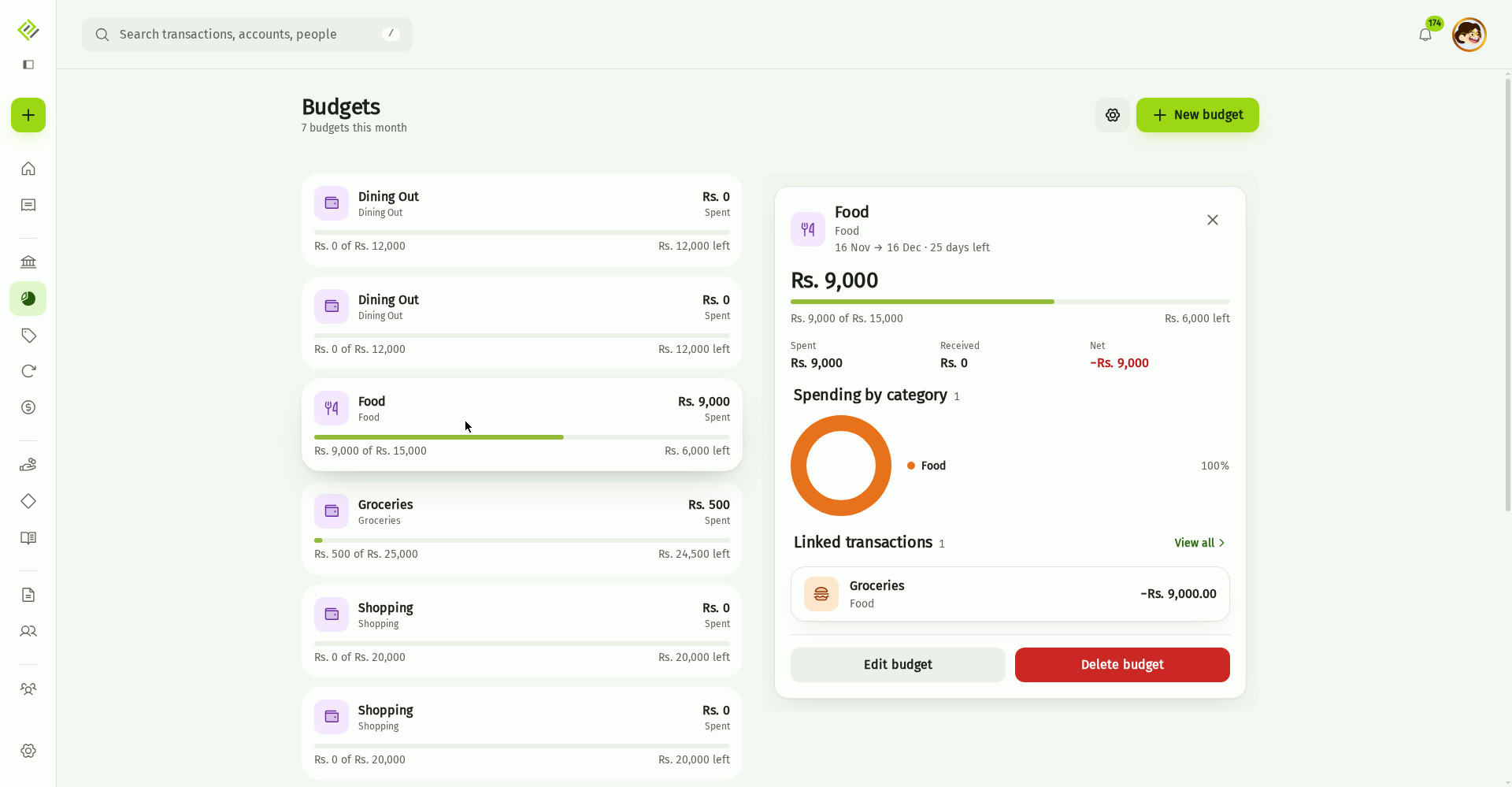
What a couple pays
The price table is the whole point for most couples. Sharing should not be the expensive part of tracking money together.
| App | What a couple pays | Sharing included |
|---|---|---|
| Lipi | Free, or Premium USD 3 a month, or USD 2 a month billed yearly (USD 24) | Shared accounts and splits free on every plan |
| Spendee | Plus $27.99 a year, Premium $44.99 a year | Shared wallets start on Plus |
| YNAB | $109 a year, no free plan | One subscription covers up to 6 people |
| Wallet by BudgetBakers | Premium about 4.49 euros a month | Group Sharing on Premium only |
| Money Lover | Premium $19.99 once | Shared wallets on the free plan, budgets for shared wallets added recently |
| Monarch | $99.99 a year, no free plan | Household sharing in the one subscription |
| Simplifi | $6.99 a month, billed yearly | Shares with one other person, no extra cost |
| PocketGuard | $74.99 a year, no free plan | Shared profile, same login |
| EveryDollar | Premium $79.99 a year | Spouse sharing (Household) |
Prices are each app's own published rate, checked 20 November 2026, except EveryDollar Premium at $79.99 a year, verified 19 November 2026. Spendee's website prices differ from its App Store prices; the table uses the App Store figures.
Over five years the gap turns into real money. Lipi Premium costs $120 over five years billed yearly. Spendee Plus costs $139.95. YNAB costs $545, Monarch $499.95, PocketGuard $374.95, EveryDollar $399.95. A couple that stays with Lipi on the free plan pays nothing for the sharing itself, and the free plan is the whole couples workflow: shared accounts, splits, 2 accounts and 3 active budgets. Premium, at USD 3 a month, or USD 2 a month billed yearly (USD 24), lifts the caps.
The honest limit
Lipi is not a joint bank account, and this page will not pretend otherwise. It tracks shared spending, it does not hold funds or move money. Rent still leaves your bank account the way it always did, and the settle-up payment at the end of the month still happens in your banking app. Lipi also has no automatic bank sync: nothing imports itself, and both partners type their entries by hand.
That is a real limit, and it decides the pick. If you want an app that pulls both partners' bank accounts in by itself and sorts the shared spending for you, Lipi is the wrong choice, and Monarch or YNAB will do that job better. What you give up with them is the price and the privacy: a subscription of $99.99 or $109 a year, a bank login handed to a third party, and in Monarch's case a household where every member sees all connected data. What you get with Lipi is the opposite trade: five seconds of typing per expense, a shared record both partners trust, and no feed that can break, disconnect, or take 12 to 24 hours to show a transaction.
My view, after reading the reviews for this page: couples do not quit trackers because typing is hard. They quit because sharing costs extra, because the app cannot say who owes whom, or because the shared record vanished. Lipi fixes the three things couples actually quit over, and it is honest about the one thing it does not do. For a couple that wants a shared record and is willing to type, that is the better trade.
How to set it up
The setup takes one sitting together, about ten minutes.
- Both of you install Lipi and sign in. The free plan holds 2 accounts and 3 active budgets, which covers a shared account and a shared grocery budget from day one.
- Create a shared account for the pooled money: rent, utilities, the bills you both pay from one pot. The sharing guide shows the steps.
- Set one shared budget on the grocery category, since groceries are the shared cost that runs away fastest.
- For everything else, use splits. One split per bill, equal or custom shares, and the breakdown shows who owes whom until everyone has marked paid.
- Sit down once a month, right after payday, for about thirty minutes. Look back at last month, look ahead at the bills, agree on one change. The app holds the numbers; the conversation decides what they mean.
Questions couples ask
Is there a free expense tracker for couples?
Yes. Lipi's free plan covers the whole couples workflow: shared accounts, splits, 2 accounts and 3 active budgets, with no bank login. The difference from a plain bill-splitting app is that Lipi keeps the shared budget and the settle-up balance in the same book as the rest of your money.
How should couples split expenses?
Equal shares work when incomes are close. Income-based percentages work when they are not. Exact amounts work for fixed bills like rent. The method matters less than the rule: agree it in advance, log anything shared that one person paid for, and skip anything clearly personal. Lipi splits take equal or custom shares per bill, so the method can change bill by bill without rebuilding anything.
How do couples track shared expenses?
The simplest setup that lasts is a shared app where both partners log expenses from their own phones and see the running balance in real time. A shared spreadsheet works and costs nothing, but someone has to keep the maths right. A shared account in Lipi does the same job with the maths built in, and splits handle the bills that stay separate.
What is the best app to split expenses as a couple?
The best app is the one both partners open every day. For couples who want the split and the budget in one place, with no subscription for sharing, Lipi is the pick this page makes: shared accounts and splits free, a settle-up balance on every bill, and multi-currency accounts in the same book. If you want bank sync to do the logging for you, that is a different job, and the honest answer is in the section above.
Can couples keep separate accounts and still track shared spending?
Yes, and most couples do. Keep your own accounts and cards, share the bills through splits, and pool only the money you agree to pool in a shared account. Lipi never asks for a bank login, so nothing about your separate money is ever in the shared record unless you put it there.
Does Lipi work if we earn and spend in different currencies?
Yes. Accounts in Lipi hold different currencies in one book, so a couple with accounts in two currencies sees the shared spending without converting it by hand first. The split itself is recorded in the currency of the bill.
Try it together
Lipi is the expense tracker app for couples that shares budgets and splits free, and the free plan is the whole workflow.
Open Lipi with your partner, set up one shared account, and log the next shared bill as a split. By the end of the month you will know exactly who owes whom, and neither of you will have paid to find out.
Sources
- How to share an account in Lipi, Lipi (read 20 November 2026)
- How to split expenses with friends in Lipi, Lipi (read 20 November 2026)
- How to budget on a salary in Lipi, Lipi (read 20 November 2026)
- Free alternative to Spendee: Lipi for shared budgets and manual tracking, Lipi (read 20 November 2026)
Keep reading
Guide
Expense tracker app for families: Lipi for shared budgets, splits and allowance
Lipi is the expense tracker app for families: a shared account the whole household records into, splits that settle every shared bill, shared budgets for groceries, school costs and allowance, and multi-currency accounts in one book. Premium costs USD 3 a month, or USD 2 a month billed yearly (USD 24).
19 min read1 view
Guide
Free alternative to EveryDollar: Lipi for zero-based budgeting without the locked months
Lipi is the free alternative to EveryDollar for zero-based budgeting without locked months: past months stay editable, budgets and splits are free, and Premium costs USD 3 a month or USD 2 a month billed yearly (USD 24).
20 min read
Guide
Free alternative to Monarch: Lipi for manual tracking without the subscription
Lipi is the free alternative to Monarch for people who want manual tracking without a subscription: free to start, budgets and splits free, and accounts in more than one currency in one book. Monarch Core costs $99.99 a year after a 7-day trial, with no free plan.
18 min read2 views
Guide
Free alternative to Toshl: Lipi for multi-currency tracking that converts properly
Lipi is the free alternative to Toshl: multi-currency tracking that converts at the real rate, budgets and splits free, and no subscription to see your own money. Premium costs USD 3 a month, or USD 2 a month billed yearly (USD 24).
17 min read